Monday, September 13, 2010
Students develop EV that runs on wireless power
Fourteen students from the University of Karlsruhe, technology and industry have come up with an electric car that runs only with wireless power transmission. Christened as e-Quickie, the three wheeled car resembles a reclining bicycle with a driver capsule.
The interesting thing about the vehicle is it doesn’t get start by the batteries but by leaving the energy conductors on the ground.
The vehicle gets its energy from electric conducting paths on the ground. Receivers underneath the car take energy from the tracks through electric induction, directing it onward to the car’s electrical hub motor.
This is similar to systems being developed by Korea advanced institute of science and technology (KAIST) and Ingenieurgesellschaft Auto und Verkehr (IAV)
All the individual components of the car including its steering, breaks and chassis are designed by the students. Apart from these, e-Quickie’s shell is made from the carbon fiber to ensure minimal weight and the optimal aerodynamic efficiency.
The total weight of the car is 60kg, which, as per the project director, can be reduced to 40kg. The car is powered by a 2kw bicycle hub motor and achieves a top speed of 50 km/h. The batteries only serve as a buffer so are much smaller than a typical EV traction battery.
Solar Driver
.
A123 Systems Opens the Largest Lithium Ion Automotive Battery Manufacturing Plant in North America
A123 Systems, manufacturer of advanced Nanophosphate™ lithium ion batteries and systems, today announced the grand opening of the largest lithium ion automotive battery production facility in North America, based on available data. The new plant in Livonia, Mich. is expected to expand A123's manufacturing capabilities by up to 600MW hours per year when fully operational, contributing to the company's plan to expand global final cell assembly capacity to more than 760MW hours annually by the end of 2011. The opening of the Livonia factory comes just over one year after A123 was awarded a $249 million grant from the U.S. Department of Energy (DOE) as part of the American Recovery and Reinvestment Act to help the company execute its strategy to ramp up U.S. manufacturing capabilities to meet increasing, market-driven demand for its innovative technologies.
"The opening of our Livonia facility is a significant milestone and confirms that we are accomplishing our stated objectives that accompanied the DOE grant. Bringing this factory on line in just over a year is a testament to our technology innovation and strategic plan to ramp up manufacturing, but it also speaks to the maturity of the market—without significant customer demand for our products today, a capacity expansion of this magnitude would not be possible," said David Vieau, president and CEO of A123 Systems. "We are grateful to the DOE, the state of Michigan and everyone else who helped make this vision a reality. Over the next several years, we expect to create thousands of jobs in greater Detroit and plan to continue our expansion in the area as we do our part in helping the U.S. emerge as a global leader in the production of advanced lithium ion batteries."
A123 will focus on manufacturing prismatic cells and systems at the new 291,000-square-foot Livonia facility. The factory is designed to enable the complete production process, including research and development, manufacturing of high-value components, cell fabrication, module fabrication and the final assembly of complete battery packs ready for vehicle integration. As part of its continuing U.S. manufacturing ramp up, A123 also plans to open a coating plant in Romulus, Mich., expected to come on line during the first half of 2011. In addition to the DOE grant, the company received $125 million in state incentives from Michigan as part of its 21st Century Jobs Fund to help finance these manufacturing facilities.
"When I signed Michigan's first-in-the-nation battery tax credits into law, it signaled my administration's intent to make our state the advanced battery capital of the world," said Michigan Gov. Jennifer M. Granholm. "This set the stage for the tremendous collaboration between A123, the Department of Energy, the Michigan Economic Development Corporation and state officials that led to this state-of-the-art battery manufacturing facility in Livonia. We applaud A123 for selecting Michigan as the center of its U.S. manufacturing, creating new jobs and helping diversify our economy."
A123's advanced lithium ion batteries and systems are designed to help customers quickly and cost-effectively take game-changing solutions from conception to commercialization. A123 is the first major U.S.-based battery manufacturer to receive TS 16949 certification for its cylindrical lithium ion cells for automotive applications, validating that the company's product design and manufacturing processes meet the highest standards for excellence in the automotive industry. A123's growing list of customers includes BAE, Eaton, Fisker, Navistar, Shanghai Automotive Industry Corporation (SAIC) and other global automakers and heavy-duty vehicle manufacturers. The company's innovative technologies are also being implemented in a wide variety of commercial products, and the company has also delivered more than 20MW of its Smart Grid Stabilization Systems (SGSS) to customers worldwide, making A123 the world's largest producer of lithium ion batteries for ancillary services for the power grid.
.
Fujitsu Develops High-Efficiency Wireless Charging Systems
Fujitsu Laboratories Limited today announced the development of wireless recharging technology that enables the design of magnetic resonance-based wireless charging systems that can simultaneously recharge various types of portable electronic devices.
This technology not only promises more compact and more efficient power transmitters and receivers, it also offers the ability to design charging systems in 1/150th the time currently required. In addition to dramatically shortening development times, this technology paves the way to integrating compact wireless charging functions into mobile phones and enabling multiple portable devices to be charged simultaneously without any restrictions on their position with respect to the charger.
Details of this technology are being presented at the 2010 conference of the Institute of Electronics, Information and Communication Engineers (IEICE), opening September 14 at Osaka Prefecture University.
Background
Wireless charging has become an increasingly desirable technology in recent years, as people are eager to avoid the clutter and inconvenience of using power cables to recharge their mobile phones, digital cameras, notebook computers, and other portable electronics.
Electromagnetic induction and magnetic resonance are the methods most often used for wireless charging. With electromagnetic induction, a magnetic flux is induced between the power-transmitting and power-receiving coils, and operates based on electromotive force. This method has been used in cordless phones, among other equipment. The drawbacks are that the method only works over short distances, and the power transmitter and power receiver need to be in alignment, so it is effectively no different than using a charging station with a wired connection.
By contrast, the magnetic resonance method, which was first proposed in 2006, uses a coil and capacitor as a resonator, transmitting electricity through the magnetic resonance between the power transmitter and power receiver. This method can transmit electricity over a range of up to several meters, and because a single transmitter can power multiple receiving devices, developments are under way for a broad range of potential applications, charging everything from portable electronics to electric cars.
Technological Issues
When designing transmitters and receivers for use with magnetic resonance charging, the size of the device determines the size of the coil, and this, in turn, determines the optimal capacitor capacitance. The effects of stray capacitance, which depends on the shapes of the transmitting and receiving coils, and other forces, such as magnetism in the device's chassis or batteries, exert complex influences over the resonance between the transmitter and receiver. Untangling these influences and resolving them in the design phase takes a significant amount of time. Using a high-end personal computer, just the basic design for a transmitter and receiver can take roughly 24 hours, and the smaller the devices are, the more difficult the computations. This has made magnetic-resonance charging impractical to incorporate into mobile phones, where miniaturized transmitters and receivers are highly prone to external influences.
Furthermore, charging multiple different devices at the same time brings a different set of influences for each device, and analyzing these complex influences has been extremely difficult. Implementing wireless charging for compact portable electronics that require complex designs has been slowed mainly by the technological problems associated with design and analysis.
The Newly Developed Technology
What Fujitsu Laboratories has done is to develop technology that dramatically shortens the time required to design transmitters and receivers for magnetic resonance charging systems and, in addition, enables accurate tuning of resonant conditions in the design phase, even for compact transmitters and receivers that are prone to influences from nearby metallic and magnetic objects.
The new technology has the following characteristics:
1. A magnetic field analysis simulator which analyzes the coil model and a specialized circuit simulator which analyzes the resonance conditions, including the capacitor model, are combined, making it possible to quickly and accurately design wireless charging systems for multiple transmitters and receivers at once using a variety of coil sizes.
2. The design of the wireless charging system can be automated to precisely match the desired resonance requirements, based on an assessment function which maximizes the charging efficiency.
Together, these two technologies represent the world's first practical magnetic resonance design simulator which enables rapid and precise designs for transmitters and receivers according to the desired resonance requirements.
Results
This analysis and design technology was used to design a compact, slim power receiver, and to manufacture prototype mobile phones with built-in wireless charging. The prototype mobile phones can charge anywhere within the power-transmitter's range, regardless of their position in reference to the transmitter, with 85% efficiency.
Charging performance varies with changes in the size of the transmitter's coil in an analysis of the simultaneous charging of multiple devices, where a single transmitter was transmitting to three receivers. This analysis, which found the optimal coil size for efficiently charging three devices, took roughly 10 minutes, or 1/150th the time it had taken before. Even with multiple transmitters and receivers, the design time is dramatically reduced.
Future Development Plans
Fujitsu plans to continue using this analysis and design technology in research and development on wireless charging systems for mobile phones and other portable devices, and plans to bring products using it to market in 2012. The company is also looking at applying the results of this work to fields other than portable electronics, including power transmission between circuit boards or computer chips, and providing mobile charging systems for electric cars.
Friday, September 10, 2010
Power struggles: Charging tomorrow's cars
Imagine driving across America using a fuel so new you have to carry your own supply wherever you go.
At the start of the 20th century, before the era of ubiquitous gas stations, drivers did just that as they tested the limits of cars like the Ford Model T, which ran on gasoline, kerosene or ethanol and could, if driven carefully, travel more than 150 miles on a full tank.
Now a new generation of drivers is set to embark on a similar experiment. Until recently, most electric vehicles have had a range of just a few dozen miles, limiting their usefulness and appeal. That is a big reason the long-talked-about era of electric vehicles has been talked about for so long with little real-world progress.
Over the next couple of years, though, tens of thousands of electric cars will hit the laneways of Europe, the streets of the United States, and the gleaming highways of Asia. These new battery-powered vehicles have much longer ranges than their predecessors -- up to 250 miles in the case of the Tesla Roadster, but mostly about 100 miles -- and are likely to be the first to sell in large numbers.
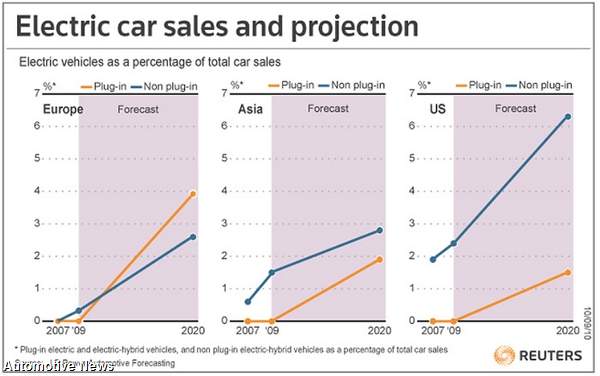
By 2020, says J.D.Power Automotive Forecasting, annual sales of electric vehicles will reach 2 million. Banking giant HSBC is even more optimistic and puts the figure at 9 million. That still falls short of the 61 million gas- and diesel-driven vehicles sold around the world in 2009, but a huge leap from the 5,000 or so EVs sold last year.
Even as these shiny new vehicles take to the road, serious questions remain about the infrastructure -- or rather, the lack of infrastructure -- to charge them. In an echo of last century's battle over the best fuel source, the way in which the coming fleet of electric vehicles will be recharged has not been settled -- and all the proposed models have flaws.
Some experts believe EVs should plug in at a driver's home or workplace. Others back a global network of roadside recharging stations. One prominent company is pushing the idea of gasoline station-like outlets where you can zip in and quickly switch your almost-dead battery for a fully charged one. Another group advocates avoiding "pure" EVs and the problem of charging infrastructure altogether, focusing on hybrid cars.
A $473 billion market?
The stakes are huge: the pace of the shift to electric vehicles, progress in the fight against climate change, and a market that HSBC Group bullishly forecast this week would grow 20-fold by 2020 to $473 billion -- a fifth of the entire low-carbon economy.
Despite the hype, it is almost impossible to predict the format or formats most likely to win the great electric vehicle infrastructure battle. Model T owners adopted gas as their fuel of choice for reasons both obvious -- the falling price of gas -- and unpredictable: prohibition in 1919 forced ethanol off the market.
The variables today -- technology, political interference, the psychology of car-lovers -- are similarly hard to pin down.
"The introduction of electric vehicles is more than a financial matter," says U.S. analyst Sam Jaffe, research manager at IDC Energy Insights. "It's a big anthropological experiment. There's no question that there are drawbacks, but there are also advantages. It requires a resetting of mindsets and how that unfolds will decide who wins the race."
On your marks, plug in
The starting grid for the coming electric vehicle race is filling up quickly. Mitsubishi Motors Corp.'s jelly bean-shaped i-MiEV has been on sale in Japan since April and will launch in the United States and Europe over the coming few months. The Japanese automaker is also making two versions of the car for French automaker PSA Peugeot Citroen.
Nissan is set to roll out its edgy-looking Leaf in December, while corporate partner Renault will start selling its mid-sized Fluence ZE (for zero emissions) in the first half of next year.
Europe's biggest automaker Volkswagen AG, a late entrant in the competition, plans to launch all-electric vehicles in 2013, though it says zero-emission vehicles will account for 3 percent of sales by 2018.
These "pure" electric vehicles face competition from hybrid cars. These vehicles can charge at a plug-in socket or switch over to gasoline, and include General Motors' Chevrolet Volt, which goes on sale in the United States this year for $41,000, and in Britain a year later.
Will the charging infrastructure be able to keep up with all those new cars? The question is critical.
"If it's too difficult to charge an electric vehicle, too inconvenient, the customers will not buy them," says Christian Feisst, managing director of business development for smart grid at U.S. networking giant Cisco Systems.
"Today a lot of the work is around battery technology and the behavior of customers. There is not a lot of work done around the charging technology, or the charging process itself, nor how to manage charging."
A battery prophet
One company that is sinking millions into technology is Better Place, a three-year-old California firm that has raised about $700 million from investors and imagines a vast global network of "switch stations." These gas station-like outlets allow drivers to swap a spent battery with a fully charged one in a few minutes.
Led by soft-spoken Israeli-born founder Shai Agassi, a former executive at SAP, the company boasts of having built "the largest cleantech investment in history."
Last January, HSBC bought a 10 percent stake that valued Better Place at $1.25 billion. Since earlier this year, the eco firm has been running a trial in Tokyo using three taxicabs and will soon start testing a small network of stations in Israel, where it says it has deals with 92 corporate fleet owners.
It expects a commercial launch in Israel and Denmark in late 2011, and has plans in five other countries, including Australia, China, and the United States.
.
Superbike Featuring Balqon's Electric Drive System Wins TTXGP eGrand Prix
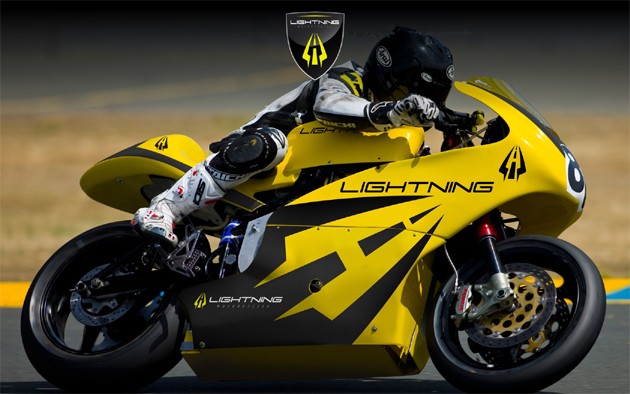
Balqon Corporation, a developer and manufacturer of zero emissions, heavy-duty electric vehicles and drive systems, announced that Lightning Motorcycle's Balqon-equipped superbike won the 2010 TTXGP North America electric motorcycle racing championship held at the VIRginia International Raceway in Southern Virginia.
Thanks in part to the unique performance capabilities of Balqon's electric power technology, Lightning Motorcycle team rider Michael Barnes dominated the TTXGP North American circuit, taking wins in three out of five races this season. One of Barnes' wins came in the final race of the season, during which he accelerated to speeds of up to 134 miles per hour on the straights.
The result of years of development by Lightning Motorcycle's founder Richard Hatfield and a crew of collaborators, the winning superbike was powered by an A123 lithium-ion battery pack, an EV1 3 phase AC motor and a Balqon electric drive system that featured Balqon's flux vector motor controller.
Balqon's flux vector motor controller regulates the flow of power between the lithium-ion battery and the AC motor during acceleration and regenerative deceleration. Balqon's proprietary software used in its flux vector controller emulates a gas engine's response and compression, making it easier for a rider to adapt to the unique performance characteristic of a high-power AC motor.
The TTXGP circuit has provided a unique testing ground for Balqon, which is more widely known for developing zero-emissions heavy-duty electric vehicles.
"This win at the world's first zero-carbon, clean-emissions superbike grand prix represents one of the most powerful demonstrations of the unique capability of our drive technology, as well as its potential broader applications," said Balwinder Samra, President and CEO of Balqon Corporation. "This racing experience has helped us further test and validate the design, reliability and performance of our drive systems under extreme duty cycles, while also promoting our newest technologies."
GM Ventures Makes Strategic Investment in Sakti3
Sakti3, Inc., an Ann Arbor-based developer of next-generation lithium-ion batteries, today announced the investment of $4.2M by General Motors Ventures and Itochu Technology Ventures to advance the firm’s manufacturing capabilities. The companies also plan to work together to speed commercialization of Sakti3 battery cells. The two, new strategic investors join previous investors Khosla Ventures and Beringea.
“These investments by General Motors Ventures and Itochu Technology Ventures bring us not only capital, but partnerships that will speed our commercialization efforts,” said Dr. Ann Marie Sastry, CEO of Sakti3. “Our product planning in the automotive and portables sectors will be accelerated by working with these two preeminent firms. The General Motors agreement partners us with a company that is clearly a global leader in vehicle electrification. Itochu Technology Ventures has a strong focus on energy technologies, and on growth markets in Asia. We’re very pleased to have engaged investors who will help us purposefully and quickly create our target products and address key regional markets.”
"GM Ventures is making strategic investments in new technology to support our core automotive business," said Jon Lauckner, president GM Ventures, LLC. "Our objective is to identify start-up companies that offer the best future technology for our vehicles, including next generation propulsion systems. In this case, our investment in Sakti3 gives us access to an innovative battery technology that has the potential to be a mainstream solution for electrically-driven cars and trucks of the future."
“Today’s announcement is the latest piece of strong evidence that many U.S. companies, and especially Michigan companies, are thriving as the auto industry moves toward a future of technologically advanced energy-efficient vehicles, said Senator Carl Levin (D-MI). “The investment in Sakti3’s lithium ion technology by GM is a major additional step forward. Sakti3’s solid-state advanced lithium ion battery technology offers tremendous potential for powering the next generation of electric drive vehicles in the U.S. and around the world. ”
Regrowth of manufacturing in Michigan is a high priority in the State. Said Senator Debbie Stabenow (D-MI), “As we grow America's auto industry, Sakti3 is a great example of how we can bring together our expertise in manufacturing and academia to create new opportunities and new jobs. I am pleased to partner with Sakti3, and I look forward to seeing the results of this new partnership with GM.”
Sakti3 was awarded a $3 million grant from The Michigan Economic Development Corporation (MEDC) in 2009 and has been designated as a State of Michigan Center of Energy Excellence (CoEE) in partnership with the University of Michigan.
"Sakti3 is an exciting, next-generation battery company with cutting-edge technology and a brilliant team," said Governor Jennifer M. Granholm. "We're thrilled that Sakti3, one of our Centers of Energy Excellence, has chosen Michigan as the place to bring its breakthrough technology to scale."
Thursday, September 9, 2010
Audi Launch Wankel Rotary powered Plug-in Fleet with A1 e-tron
Project partners Audi, E.ON, the Munich municipal utility company Stadtwerke München (SWM) and the Technical University of Munich (TUM) today sounded the starting gun for a fleet trial with electric cars in the Munich model region. By the middle of next year, 20 Audi A1 e-tron models will successively take to the region's roads and around 200 new charging stations will be installed. The "eflott" project is part of the "Model Region Electromobility Munich" sponsored by the German Federal Ministry of Transport. It will address a number of issues from the data transfer between the driver, vehicle and electric filling station to the power grid. It will also include a test of smartphones as the central interface for the driver.
The Audi A1 e-tron is an innovative Mega City Vehicle (MCV) with an electric drive. It has a range of more than 50 kilometers in city traffic and a peak power output of 75 kW (102 hp). A compact internal combustion engine recharges the battery when its energy is depleted. Top speed is 130 km/h (80.78 mph). The compact MCV is a zero-emissions vehicle for the first 50 kilometers (31.07 miles) that it is underway, such as in city traffic. The battery comprises a package of lithium-ion modules mounted in the floor assembly in front of the rear axle.
A small, single-rotor Wankel engine in this near-series vehicle increases the range in exceptional circumstances. This “range extender” powers a generator that produces 15 kW of charging power. If the range extender is used to recharge the battery, the A1 e-tron can cover an additional 200 kilometers (124.27 miles) of range. According to a draft standard for the computation of fuel consumption for range extender vehicles, this represents a fuel consumption of 1.9 l/100 km (123.80 mpg) – a CO2 equivalent of only 45 g/km (72.42 g/mile).
E.ON and SWM are installing the necessary charging infrastructure; E.ON primarily in the outlying areas and SWM in the Bavarian state capital. The two utility companies are initially installing a total of 100 “electric filling stations” each as part of a variety of projects. All of the charging stations are supplied with electricity generated from renewable energies.
The Technical University of Munich is responsible for comprehensive data collection and evaluation of mobility behavior. How heavily and in which situation is the electric car being used? And what influence does this option have on the use of other means of transportation? To answer these questions, the Department of Vehicle Engineering has developed a mobile application that will be provided on a smartphone to all participants of the fleet trial. The device will thoroughly document their mobility behavior – from their use of bicycles to the electric cars and from conventional cars to buses and trains. To ensure that the participants always use the smartphone, the Department of Ergonomics made sure that the application features an easy-to-use design that encourages use over the long-term. At the same time, the Department of Marketing is conducting a study to discover which billing models for the electricity used for e-mobility meet with the greatest acceptance.
The fleet trial is being supported by the German Federal Ministry of Transport as part of a publically-funded project. “Electromobility is not an abstract technology issue. At its core is the question of how the transportation systems of the future should look. We are therefore funding electromobility under real-world conditions in our model regions – a large field test, so to speak. Projects like these provide us with important insight into how to make electromobility a success, both in the city and in rural areas. In the Munich model region, we are providing approximately €10 million in funding for electromobility. This money is a smart investment in the future. Our goal is clear: We want to make Germany the lead market for electromobility and put at least one million electric vehicles on German roads by 2020,” says Federal Transport Minister Peter Ramsauer.
“Audi is working hard on the future of mobility. “We are trying to find a concept that requires no compromises,” says Rupert Stadler, Chairman of the Board of Management of AUDI AG, who continues, “Electromobility means more to us than just electrifying conventional cars. Instead we are dedicated to a holistic approach to all aspects of the topic. We hope that this fleet trial will enable us to gain broad insights into the behavior but also the expectations of our customers regarding their dealings with electric cars. Of course, the data that we will collect are another aspect. This market and technology feedback will enable us to further expand our expertise in electrification.
Klaus-Dieter Maubach, Member of the Board of Management of E.ON AG, Technology, adds, “In this project, we are shifting the locations of our electric filling stations to existing parking lots as was suggested by our knowledge of user behavior. We are equipping private garages or parking garages, for example, with charging stations. We hope that this will allow us to further develop the technology of the charging points and the communication with the grid operator, in particular, and thus secure our leadership role in the development of electric filling stations. Intelligent charging points are more than just electric filling stations. They are the prerequisite for using vehicle batteries as intermediate storage for renewable energies in the intelligent power grids of the future.
As an operator of subways and trams, SWM has decades of experience with electric mobility in short-range public transportation. The expansion of the charging infrastructure marks their entry to the field of sustainable individual mobility. “The SWM charging stations will 'pump' nothing but our green electricity," says Dr. Florian Bieberbach, Commercial Director of SWM, reducing the vehicles’ CO2 emissions to zero. Our efforts to expand renewable energies is the foundation allowing us to do this. By 2025, we hope to generate enough green electricity in our own plants to meet the electricity needs of the entire population of Munich – including the requirements of electric vehicles. This would make Munich the first city of over one million inhabitants to achieve this ambitious goal.”
“For researchers, it is no longer a question of whether electric mobility will be able to establish itself, but rather of when. Electromobility means a paradigm shift for industry and society, making it a central strategic focus of the TUM,” says Professor Wolfgang A. Hermann, President of the Technical University of Munich. “The Science Center for Electromobility at TUM pools the expertise of 42 departments from eight schools, which are working hard to contribute to the development of sustainable individual mobility.”
Subscribe to:
Posts (Atom)