Showing posts with label Battery Electric Car. Show all posts
Showing posts with label Battery Electric Car. Show all posts
Thursday, December 29, 2011
Close-up Look @ the Wheel Motor powered SIM-LEI [video]
The SIM-LEI, an electric car developed by a spin-off startup at Keio University in Tokyo in collaboration with a total of 34 domestic and foreign companies, says it is on track to start mass-producing the vehicle in about 2 years.
The SIM-LEI can travel 333 kilometres (207 miles) on a single charge of it's 24.5 kWh battery, which is approx the same battery capacity as that found in the Nissan Leaf. SIM Drive said the SIM-LEI (“Leading Efficiency In-Wheel motor”) recorded an electrical power consumption of only 77Wh/km during JC-08 mode tests. (for comparison, a Nissan LEAF consumes 120Wh/km in JC-08 mode).
A brief run down on electric vehicle dynamics to explain how this vehicle achieves 77 Wh/km.
The SIM-LEI uses Direct Drive wheel motors which eliminates the 20-30% energy loss common to a typical automotive mechanical transmission system. This direct drive energy efficiency gain translates into a matching increase in brake energy regeneration potential and that potential is multiplied by the SIM-LEI being all wheel drive, meaning it collects the maximum available regenerated energy compared to a 2WD EV (70% of vehicle braking is on the front axle).
The JC-08 test represents driving in congested city traffic, including idling periods and frequently alternating acceleration and deceleration, providing plentiful opportunity for brake regeneration.
The JC08 is conducted on a chassis dynamometer so does not test the SIM-LEI's aerodynamics which at Cd of 0.19 is the same as the tear drop shaped GM EV1 and is significantly better than the 0.28 Cd achieved by the Volt or Leaf. When you consider drag (and resulting energy loss due to aero friction) is proportional to the square of speed you begin to understand the SIM-LEI has been designed from the ground up to be a seriously energy efficient EV.
Consider that if SIM-Drive produced an EV with range equal to the Nissan Leaf it would require a battery pack with approx half the capacity = potentially halving the cost of the most expensive component in the vehicle.
The SIM-LEI is equipped with a 65kW / 700 Nm Outer Rotor BLDC PM Wheel Motor in each wheel (260kW / 2800 Nm total), an in-dash 19-inch display, and a set of side-view cameras.

Japan launch EV Service Station Network

Oil companies JX Nippon Oil, Idemitsu Kosan Co, Cosmo Oil Co. and Showa Shell Sekiyu KK are teaming up to test a fixed-fee EV charging service at their gas stations. 27 stations will be involved in Tokyo and Kanagawa Prefecture starting in the first quarter of 2012.
The four companies have created what they call an “EV Service Station Network” where members can charge their plug-in EVs at a conventional petrol station alongside internal combustion engine powered cars.
Of the four, JX Nippon Oil currently has the most participating stations, and the company is looking at a monthly fee of ¥3,000 (RM122 at current exchange rates) for individuals and corporate card holders. Pay the fee and one can recharge their EV at any participating station.
The four companies will provide additional services to customers waiting while recharging.
Ford Focus Electric Production Ramps Up in Michigan

Ford recently announced that its Michigan Assembly Plant has begun manufacturing the 2012 Ford Focus Electric, an all-electric compact car headed to Ford dealers in 19 select markets, including Boston, next year. The American automaker claims its newest model will be the first five-passenger, all-electric vehicle to achieve a miles per gallon equivalent (MPGe) of more than 100.
Ford is the first of the Big Three domestic automakers to sell an all-electric car, and it has gone to great lengths to improve on the inherent weaknesses of plug-in vehicles, particularly when it comes to charging times. It claims the Ford Focus Electric can charge twice as fast as the Nissan Leaf when connected to a 240-volt outlet, which means a full charge takes about 3.5 hours instead of seven.
"Convenience is a big problem for most electric cars, because Americans like the flexibility of just filling up the gas tank and going rather than having to plug in for an entire night," said Peter King, general manager of Watertown Ford, a Massachusetts Ford dealer. "Ford has done a great job of substantially shortening charge times, which will make the Focus Electric much easier to maintain on a day-to-day basis. That's a huge step toward widespread acceptance of the electric car."
Ford's Focus Electric won't be the only vehicle with a lithium-ion battery rolling out of the automaker's Michigan Assembly Plant for long. The C-MAX Hybrid and C-MAX Energi, a pair of fuel-sipping, gas-electric vehicles, are scheduled to reach Ford dealerships in the latter half of 2012.
The C-MAX Hybrid will be a direct competitor of the Prius v wagon, providing similar versatility with even greater fuel efficiency, according to Ford. With similarly high expectations for the C-MAX Energi, Ford claims the plug-in hybrid will have a greater range than the Chevy Volt, with 500 miles between fill-ups, while returning better fuel economy than Toyota's Prius Plug-in.
Both the C-MAX Hybrid and the C-MAX Energi will alternate their power use between a 2.0-liter Atkinson-cycle four-cylinder engine and an electric motor, depending on the needs of the driver. Thanks to Ford's innovations in electric-transmission technology, the C-MAX vehicles will be capable of using their electric motor at higher speeds and will use optimized gear ratios to improve fuel economy.
"Ford knows that drivers have fuel efficiency in the back of their minds at all times, even when gas prices are steady," added King. "The introduction of the Focus Electric and C-MAX Hybrid and Energi will provide even more choices for Massachusetts Ford fans looking to save gas or avoid the fuel pump entirely."
Wednesday, December 28, 2011
Mitsubishi Motors to launch electric light truck -Nikkei

Mitsubishi Motors Corp has started developing an electric light truck that it expects to launch in fiscal 2012, Japanese business daily Nikkei said.
The automaker's third electric vehicle, which will allow users to recharge its battery off normal household power outlets, will be targeted at farmers, contractors and others who use light trucks for their work, the paper said.
Mitsubishi Motors, who already sell a Fuso Hybrid truck, is looking to sell 42,000 electric vehicles worldwide in fiscal 2012, double the number projected for this fiscal year, the Nikkei said.
The company aims to keep the effective sales price of the electric truck after government subsidies at less than 1.5 million yen ($19,200), making it cheaper than its two existing electric vehicles, the newspaper said.
Tuesday, December 27, 2011
Andros Electrique 2011: Val Thorens [video]
It's the motor racing off-season so the means it's time for the French Alpine Ice Racing series, which again includs the EV " Electrique" class.
Each Andros Car, built by Exagon engineering, is rear wheel drive, weighs just 800 kg and is powered by a 90 Kw (122 hp) Siemens 3 phase AC electric motor with 200 Nm of torque.
Nicolas Prost, Son of four time World Formula One Champion Alan Prost, was crowned Champion of the inaugural 2010 Trophee Andros Electrique.
Mads Østberg Rallying a Tesla Roadster [video]
Norwegian WRC rally driver Mads Østberg tackled the 2011 Zero Rally in a Tesla Roadster.
Source: Zero Rally
Monday, December 26, 2011
Twice As Many Charging Stations in U.S. as Flex Fuel Stations

Public charging stations for electric cars already out number outlets for E85 fuel by almost two to one.
The BGOV Barometer shows drivers of the approximately 16,500 highway-worthy electric vehicles in the U.S. can choose from 4,448 public charging stations should they want to plug in someplace other than home or work, according to U.S. Energy Department data.
That’s one per 3.7 electric car. That compares with 2,468 places to fill up the 7.6 million vehicles that can run on E85, a fuel that is 85 percent ethanol. E85-capable vehicles, also known as flex-fuel vehicles, can run on either E85 or traditional gasoline.
The Obama administration is pushing for still more charging stations, with $230 million worth of support from the Energy Department and private investment. Ecotality Inc. (ECTY) received funds under the federal program to install 14,000 chargers in 18 metropolitan areas in six states and the District of Columbia.
The number of charging stations available today is “a good start,” said Brian Wynne, president of the Electric Drive Transportation Association. Fifteen electric models will be will be brought to market by the end of 2014.
“Bear in mind that this is going to change quite dramatically,” Wynne said of electric-vehicle demand. “We’re selling every car we make. The question is what kind of a curve are we on.”
Nissan announced Dec. 6 it would expand Leaf sales to 30 U.S. states on Dec. 11 and plans to take orders for it in all 50 states by March.
Friday, December 23, 2011
Kia Ray EV breaks cover

The Kia Ray EV, an electric version of the Korean make’s latest city car that has a range of up to 86 miles on a single charge, has broken cover. The Ray EV is a close relative of the 1.0-litre petrol-powered Ray, which went on sale in Korea last month. It is assembled on the same production lines as the regular Ray and shares that model’s major dimensions.
The front-wheel drive Ray EV is powered by a 50kW electric motor and a high-capacity 16.4kWh lithium ion polymer battery pack that is engineered for a 10-year life cycle and packaged under the rear seat and cabin floor.
The electric motor has 123lb ft of torque and has a top speed of 81mph. It can accelerate more briskly than the petrol equivalent and covers 0-62mph in 15.9sec.
The Ray EV offers the driver a choice of two modes. ‘E’ (or ‘eco’) mode optimises the delivery of the motor’s torque to achieve minimum battery consumption and maximum driving range. ‘B’ (or ‘brake’) mode can be selected when driving downhill on highways and on mountain roads to maximise braking power.
The Ray EV is destined solely for the Korean firm’s domestic market and 2500 examples will be produced in 2012 for use by government agencies.
Recharging times are six hours using a 220-volt household supply and 25 minutes in fast-charge mode. Currently there are 500 slow/fast recharge stations in Korea, and the government plans to increase that figure to 3100 stations by the end of 2012.
Wednesday, December 21, 2011
AMP plans Jeep Grand Cherokee EV

An all-electric Jeep Grand Cherokee will be revealed at the Detroit motor show next month. The vehicle is the work of Ohio-based Amp Electric Vehicles, a company that specialises in building electric SUVs.
The special Grand Cherokee will showcase Amp’s proprietary technology for SUVs and full-sized vehicles. The company has previously made a Mercedes M-class EV, and the vehicles will be made for production, with an emphasis on the fleet market.
Company chiefs are aligning the Amp Jeep Grand Cherokee with the Tesla Model S electric saloon, and the price tag for the Jeep is expected to be in the $56,000 range, the US equivalent of about £36,000.
“Beginning with a world class vehicle, and adding AMP’s electrification results in an EV that offers everything SUV customers expect: smooth powerful performance, zero emissions and up to a 100-mile range,” said Amp’s boss, Jim Taylor.
More details of the Jeep Grand Cherokee EV will be revealed at the Detroit show, which begins on January 9. Amp intends to announce further electric models during 2012.
Tuesday, December 20, 2011
Tesla unveil prices for Model S starting @ $50,000

Tesla Motors launched a Web page today showing the base model, with a 40 kilowatt-hour battery pack, costing $49,900. The 60 kilowatt-hour model runs $59,900, and it's another $10,000 jump to the 85 kilowatt-hour model. Go up to $79,900 for the Performance model, which also comes with the 85 kilowatt-hour battery pack and a zero to 60 mph time of 4.4 seconds. All of those prices are after a federal tax credit of $7,500.
Those battery packs give the Model S an estimated range at 55 mph of 160 miles, 230 miles, and 300 miles respectively. Tesla says this pricing is only guaranteed for current reservation holders. Pricing for new buyers may change when the car goes into production next year.
Unfortunately, Tesla CEO Elon Musk said in November next year’s production of its new Model S sedan has already sold out.
Source: Tesla Motors Blog
Nissan Australia price Leaf at $51,500 on sale Feb 2012

Nissan Australia has confirmed today that the Leaf electric vehicle, which opens for public orders in February before first deliveries take place in June, will be priced at $51,500 before on-road costs.
Announcing the Leaf price today, Nissan Australia CEO Dan Thompson said Nissan expected fleet buyers to comprise the lion’s share of Leaf customers in the first six months, as part of the EV ‘education process’.
However, the Leaf will be available for any customer to order from February and Mr Thompson said Nissan expects to sell “hundreds” of examples of the world’s first mass-market EV in the remaining half of next year, before annual sales volumes eventually grow to the thousands.
Private buyers will have their homes' wiring assessed to ensure it is capable of taking the 10-amp draw required to charge the Leaf on a "level one" basis.
Nissan is also recommending they upgrade to a 15-amp recharge facility - but can't yet give a price on what the "level two" charging point will cost. Nissan Australia brand manager Darren Holland said recharging via a 15-amp supply would take about eight hours if the battery was flat
Nissan Australia says it will make available Level 3, will charge the battery to 80 per cent capacity in around 30 minutes, and 4 fast-charging systems for the Leaf, which will initially be available from 13 specialist Nissan dealers in major metropolitan centres, including Hobart and the Gold Coast.
The number of Leaf outlets will be expanded in stages until 2014, by which time Nissan expects to have sales and service centres in all major provincial centres.
Nissan has sold more than 20,000 examples of the Leaf globally in its first year, making it “the highest-selling electric car in the history of the car industry”, according to the company.
“We’ve stated before that we expect to see meaningful sales volumes from Leaf as a contribution to Nissan Australia’s market growth expectations and zero-emission leadership aspirations,” he said.
“With a range of up to 170km on a single battery charge, the Leaf is expected to find favour early on in Australia’s fleets, as they seek sustainable transport solutions, and later with private customers who are interested in a zero tailpipe emission car ownership experience coupled with freedom from petrol service stations.
“Nissan dealers will be at the forefront of automotive generational change when Leaf arrives in their showrooms mid next year,” said Mr Thompson.
Nissan expects to sell at least 250,000 EVs a year by 2014, and plans to launch seven other battery-powered vehicles over the coming years. Production of Australia’s Leaf begins at Nissan’s Oppama plant in Japan next March.
Monday, December 19, 2011
Continental develops tyres for electric vehicles

Continental has developed a tyre specifically for electric vehicles which will make its first appearance on the Renault Twizy next year.
Although the new Conti.eContact tyre will initially be a niche product Continental is anticipating a big increase in global demand with electric vehicle registrations predicted to increase to 1.5 million in 2016 and 2.8 million in 2020.
Peter Robb, passenger brand manager at Continental, said that Continental has a number of implementation projects with original equipment manufacturers and he “expects to see more coming on board next year”.
Continental is also producing a winter tyres version of the Conti eContact tyre which will be introduced in 2013.
Differences from a standard tyre
The tyre has new dimensions to reduce rolling resistance. It is narrower than a standard tyre but has a larger outer diameter, which means it can carry the same load.
There is less material in the sidewall which enables more flexibility and ensures that less energy is lost, again helping with rolling resistance.
Tyre noise has been reduced by having a high number of lateral sipes and no lateral grooves.
Continental has also created a ‘BLUECO’ label which will be used to identify its electric vehicles tyres.
Drag Racing World Recognizes the Electric Vehicle
The world of electric drag racing just got a whole lot more exciting with the announcement from the International Hot Rod Association (IHRA) with the incorporation of electric vehicles into their rule book. For your average drag race fan, this change opens a new and exciting chapter on the drag race scene, not seen since the likes of the inception of the electric vehicle itself. Creating this change paves the way for emerging technologies to compete alongside their combustion engine counter parts at race tracks across Canada and throughout North America.
Akin to their top alcohol vehicles and motorcycles, the time for electrics has come. With the rapid development in battery technology, electric drag racers are getting faster with each passing month. The race track also provides a platform for battery research and development which helps pave the way for the further evolution of the electric vehicle movement.
The National Electric Drag Racing Association (NEDRA) and the IHRA have formally recognized electric cars and motorcycles, including electric junior dragsters are now in their 2012 rule book. The IHRA, formed in 1970, is the largest drag racing sanctioning body in Canada and the second largest in the US.
It has been a landmark year for NEDRA in Canada with the creation of Canada's only electric drag racing chapter and the appointment of Casey Mynott as NEDRA's Canadian West Coast regional director. 2011 will also be marked as historic for Canadian drag racing with the debut of Canada's first electric drag racing vehicle, including a record setting run with the Delta Secondary School Drag Racing team, lead by Mynott. "We are extremely excited by this move from NEDRA and the IHRA," states Casey Mynott, Delta Secondary Automotive Instructor and NEDRA regional director. "This development continues to push the envelope for electric drag racing and provides a great platform for further expansion of our high school electric drag racing program."
Mynott and his students from Delta Secondary School spent two years converting a 1989 Toyota pickup truck to Canada's first electric drag racing truck earlier this year, setting Canada's first and fastest electric drag racing record. 2012 will provide new opportunity for Mynott and his students with the addition of a junior dragster to their racing program.
The National Electric Drag Racing Association (NEDRA) and the IHRA have implemented this historical change which will smooth the way for new, exciting and safe electric vehicle (EV) drag racing events.
Thursday, December 15, 2011
VW launch Caddy EV test fleet

VW has launched an EV test fleet based on the VW Caddy van. The Wolfsburg-based group will be testing electronic mobility for its commercial feasibility in the city of Hannover and with “other partners,” according to Volkswagen, with an electric Caddy fleet totaling 7 vehicles in all.
The electric Caddy will retain its 140 cubic feet of storage space, since the lithium ion batteries are built right into the floor, and its 85kW electric motor took the high-roofed wagon to a regulated high speed of just under 75mph during testing. The electric Caddy should be able to haul loads of over 1200 lbs. and VW claims it has a range of 68 miles.
Ford Focus Electric first Production EV to hit 100MPGe

The all-new, gasoline-free Ford Focus Electric is the company’s first-ever all-electric passenger car – a zero-CO2-emissions version of Ford’s popular small car expected to be the first of its kind to achieve the equivalent of a 100 miles per gallon fuel efficiency rating with seating for five.
Two of its main rivals in the US, the Nissan LEAF and Chevrolet Volt, come close, achieving 99MPGe and 93MPGe, respectively.
Focus Electric is the flagship of Ford’s transformed lineup, one-third of which will feature a model with 40 mpg or more in 2012, building on the company’s commitment to give fuel-efficiency-minded customers the Power of Choice.
Focus Electric also is the first all-electric vehicle to feature faster charging technology, allowing it to fully recharge in three to four hours – half the time of Nissan Leaf. This technology can help double the car’s range during a busy day of driving and recharging multiple times.
“Focus Electric’s innovative faster charging technology can help customers save money and get much more out of the car in a busy day of running around town and recharging between stops,” said Sherif Marakby, director of Ford’s Electrification Programs and Engineering. “We also are pleased the Focus Electric will break the 100 MPGe mark – a great symbol of how Ford has transformed its fleet with many vehicles delivering leading fuel economy and efficiency.”
With 20 years of Ford research and innovation behind electrified vehicle software and hardware technology, the company offers proven engineering and design with Focus Electric. Ford holds approximately 500 patents, with several hundred patent-pending applications on technologies used in the new Focus Electric and its other electrified vehicles.
Ford began taking orders for the 2012 Focus Electric in November through Certified Electric Vehicle Dealers in California and New York/New Jersey markets. In 2012, availability of the Focus Electric will expand to another 15 launch markets as production ramps up.
Focus Electric reflects Ford’s commitment to deliver fuel-efficient vehicles without sacrificing performance, capability or driving fun. Though range and miles per gallon equivalent figures are yet to be finalized, Focus Electric is expected to be competitive with other comparable all-electric vehicles.
“Focus Electric was designed to deliver the same dynamics and quality of a conventional Ford Focus,” said Eric Kuehn, Focus Electric chief nameplate engineer. “It shares many of the same premium components and features as its gasoline-powered counterpart while delivering distinct efficiencies and a uniquely exciting driving experience.”
A battery of quality
Focus Electric will be powered by an advanced lithium-ion (li-ion) battery system with an advanced active liquid cooling and heating system to precondition and regulate the temperature in its larger, more complex battery system.
The active liquid system heats or chills a coolant before pumping it through the battery cooling system. This loop regulates temperature throughout the system against external conditions. On hot days, chilled liquid absorbs heat from the batteries, dispersing it through a radiator before pumping it through the chiller again. On cold days, heated liquid warms the batteries, gradually bringing the system’s temperature to a level that allows it to efficiently accept charge energy and provide enough discharge power for expected vehicle performance.
The durability and longevity of batteries – which Ford has been developing and testing since the 1980s – is essential as the company expands its electrification plan. To date, among the nearly 43 million battery cells Ford has tested or seen put to work in customer vehicles, only five issues have been documented.
Plug and play… and save
Even with relatively stable gas prices, fuel economy is the top purchase consideration for new vehicles. Nearly 45 percent of customers say fuel economy is their top consideration based on a Ford survey of Americans in 36 cities this fall. Styling was the next consideration, with only 16 percent of study participants saying it was their top purchase driver.
The fuel efficiency of Focus Electric sets it apart from other vehicles. For example, the cost to travel 80 miles is $2.10 – based on the amount of energy it takes (measured in kilowatt-hours) and the national average cost of a kilowatt-hour. Driving 80 miles in a competitive gasoline-powered vehicle that gets 30 mpg would cost $8.80, based on a per gallon cost of $3.30.
A unique “set it and forget it” value charging feature, powered by Microsoft, is designed to help owners in the U.S. charge their cars when the utility rates are lower. The tool aims to help customers avoid unnecessary expense by providing an optimized charging solution. In the future, these smart charging habits can help utility companies understand and better manage the demands placed upon the electric grid because of electrified vehicles.
Focus Electric is the first all-electric vehicle to offer faster charging technology, allowing a full recharge in three to four hours with the 240-volt charge station – half the time of the Nissan Leaf.
Ford and SunPower Corp. have teamed up to offer customers a rooftop solar system that can provide enough clean, renewable energy to offset the electricity used to charge the car.
The car’s charge port – conveniently located on the left front fender – activates a light ring that illuminates the port twice when plugged in. The light ring then illuminates in quadrants as the car charges. Each quadrant represents 25 percent of the maximum battery charge.
Flashing quadrants represent charge in progress and solid-lit quadrants show stages of charge completion. When the entire ring is solidly lit, the car is fully charged.
Technology for more efficient driving, better MPGe
Focus Electric’s SYNC® with MyFord Touch® driver connect technology was specifically developed for electric vehicle owners and displays key information such as battery state of charge. The system’s MyView feature allows drivers to access even more vehicle data including the electrical demands of such accessories as air conditioning, which can impact driving range.
Drivers also can input destinations, including their next charge point, into the car’s MyFord Touch map-based navigation system, and the car will coach drivers on how to achieve the desired range – or advise if travel plans need to be adjusted. The on-board navigation system provides an EcoRoute option based on characteristics of efficient electric vehicle driving.
The Focus Electric’s next-generation SmartGauge® with EcoGuide fuel economy coaching system features a cluster display that uses blue butterflies to represent the surplus range beyond the driver’s charge point destination. The more butterflies there are, the more surplus you have to get to your final destination.
At the end of each trip, a display screen provides distance driven, miles gained through regenerative braking, energy consumed and a comparative gasoline savings achieved by driving electric.
Remote control
Off-board, Focus Electric owners will be able to maintain constant contact with the car anywhere they have a mobile phone signal using the Ford-developed MyFord® Mobile app. MyFord Mobile enables access via a smartphone or Web-based interface to:
- Receive instant vehicle status information
- Perform key functions remotely
- Monitor the car’s state of charge and current range
- Get alerts when it requires charging or has finished charging
- Remotely program charge settings and download vehicle data for analysis
- Locate charge stations and plan routes to find them
The feature also allows the owner to program the car to use electricity from the grid to heat or cool the cabin while plugged in – called preconditioning. For example, during hot summer months, owners can preprogram the car the evening before to be fully charged – and fully cooled to a particular temperature – by a certain time the following morning.
Working with MapQuest®, MyFord Mobile can communicate charge station information and other points of interest to Focus Electric using SYNC Services. Turn-by-turn guidance is provided by the in-car map-based Navigation System. Drivers can also get up-to-date charge station information directly to their car simply by connecting to SYNC Services.
Engaging to drive, too
Not only is Focus Electric designed to provide outstanding energy efficiency and reliable operation, it also delivers real driving enjoyment. The all-electric powertrain and single-speed transmission provide immediate responsiveness and smooth acceleration when the driver pushes down the accelerator; it’s expected to achieve a top speed of 84 mph (136 kph).
Much of the Focus Electric’s steering, handling and braking feel is shared with the agile, sporty, fuel-powered five-door hatchback Focus model upon which it’s based. At the same time, the vehicle’s absence of gasoline or diesel engine and its outstanding aerodynamics lead to a remarkably quiet, comfortable in-car experience.
Focus Electric offers a host of standard safety and security features including six airbags, electronic traction control and MyKey® for North America. The Focus Electric is the industry’s first car to feature 100 percent sustainable clean technologies in interior materials, including seat fabrics with REPREVE®-branded fiber made from recycled plastic bottles inthe seat fabric
Other standard features on Ford Focus Electric for North American customers include 15-spoke 17-inch aluminum wheels, a 60/40 split rear bench seat, push-button start, AM/FM/CD/MP3 Sony® Audio with nine speakers, SiriusXM Satellite Radio and HD Radio™. Also included is a free, three-year subscription to SYNC Services, which provides access to information about traffic, news, sports, weather, horoscopes, stock quotes and movie listings, along with business searches and turn-by-turn directions.
All Focus gasoline and electric variants to be sold in North America will be built at Ford’s Michigan Assembly Plant in Wayne, Mich., with production powered in part by one of the largest solar energy generator systems in the state.
Honda EV-STER Concept headed for production

The Honda EV-STER Concept is reportedly set for production. The fully electric compact convertible was unveiled at the 2012 Tokyo Motor Show last month.
In a recent interview with Auto Motor und Sport, Honda CEO Takanobu Ito said the EV-STER could be produced not only as a pure electric vehicle, but also as a petrol-powered model. Other finer details are limited, but the report says the production version could appear as early as 2012.
As the name suggests, the EV-STER Concept is an electric vehicle. It’s powered by a 58kW lithium-ion motor which is capable of propelling the compact rear-drive roadster from 0-60km/h in 5.0 seconds.
Tuesday, December 13, 2011
FedEx test Nissan NV200 Electric Van on Streets of London

A prototype zero-emission all-electric delivery vehicle is ready to start extensive real-world testing on the streets of London. FedEx Express and Nissan are collaborating over a two month period to evaluate how the NV200 electric vehicle (EV) prototype copes with the rigours of daily duties in the capital.
The Nissan NV200 EV prototype uses the same EV powertrain and battery originally developed for the multi-award winning Nissan LEAF - the world's first 100 per cent electric mass-market family car: 2011 European Car of the Year, 2011 World Car of the Year, and Car of the Year Japan 2011-2012. To date Nissan already sold more than 20,000 Nissan LEAFs, making it the best-selling all-electric car across the globe.
Beth Galetti, vice president of Planning and Engineering, FedEx Express EMEA (Europe, Middle East, Indian Subcontinent & Africa) said, "FedEx is proud to collaborate with Nissan on this initiative. Our cross-sector approach to reduce dependence on petroleum, reduce carbon impact and eliminate tailpipe emissions remains unwavering. At FedEx, we seek to connect the world in responsible and resourceful ways and we will continue to work closely with Nissan to change what is possible."
"Zero-emission vehicles like Nissan LEAF are already playing an increasingly significant environmental role in our towns and cities. The Nissan NV200 EV prototype delivery vehicle will not only improve the quality of urban life, but thanks to best in class running costs has great potential to ease the economic burdens placed on companies," said Nissan Corporate Vice President Hideto Murakami, responsible for the Global LCV Business Unit, "FedEx Express feedback from the evaluation process will help us tailor a future battery-powered light commercial Nissan vehicle that meets customer needs."
"Collaboration is part of our global vehicle strategy," explained Dennis Beal, Vice President of Global Vehicles for FedEx Express. "Through collaboration we can exponentially improve and expedite what is possible. We value the opportunity Nissan has given us to provide experienced feedback and contribute to development of the best Nissan NV200 possible."
FedEx Express currently operates 43 all-electric vehicles in London, Paris, New York, Los Angeles, Chicago and Memphis- all of which are ideal dense urban centres. With zero emissions, no tailpipe, and energy-recycling regenerative braking, the Nissan NV200 EV prototype is particularly well-suited for congested city streets where poor air quality is causing increased concern and the start and stop of city traffic reduces the wasteful loss of energy and thus increases the efficiency of the vehicle's driveline. Battery charging options include a complete recharge overnight or up to 80 per cent capacity in just 30 minutes using a Quick Charger.
Nissan is aiming to become the global leader in zero emissions and sees the application of its advanced zero emission technology to the LCV and business-to-business markets as an important next step in the development of sustainable mobility for all.
Additional trials are anticipated for 2012 mirroring similar trials held in 2011, where the NV200 EV prototype was used by the Japan Post Service on delivery and collection duties in Japan.
Nissan expects Leaf sales to double in 2012

Nissan is expecting its Leaf electric car to reach a sales capacity of 40,000 units next year, a top executive told Financial Times.
Nissan says it has alrealdy sold more than 20,000 Leafs from the car’s debut in December 2010 to late November 2011. Most of the cars were sold in Japan and the United States. Andy Palmer, Nissan’s managing director of business strategy and corporate planning said Leaf sales were slightly behind expectations in 2011.
The Leaf’s launch was delayed by a month in the U.S. because of distribution problems, while the Japan earthquake and tsunami in March disrupted supplies of some of the electronic components used in the Leaf. On top of that, the Oppama plant in Japan that builds the Leaf closed for about three weeks.
Palmer added that orders for the car are strong and could determine Nissan to double sales to 40,000 in 2012, as the Leaf will be introduced in more European countries and U.S. states. “That’s our aim: to double that volume, which is basically buffering up against our capacity,” Mr Palmer was quoted as saying by the Financial Times. Nissan also plans to build the car at its U.S. plant in Smyrna, Tennessee and in Sunderland, England, from 2013.
Monday, December 12, 2011
Can In-Wheel Motors spark an electric car revolution

There may have been more alluring electric cars on display at this year's Tokyo Motor Show, but the beauty of this prototype lies in its performance.
The SIM-LEI can travel 333 kilometers (more than 200 miles) on a single charge, say its Japanese creators SIM Drive, and it also boasts supercar-like acceleration -- 0 to 60 mph in just 4.8 seconds.
The key to these remarkable statistics lies not, as you might expect, underneath the hood but in its wheels.
Most electric vehicles house a single motor in the area vacated by the petrol engine, but the SIM-LEI has four motors, which fit in its wheels.
Each one delivers 65 kilowatts, giving the car a total output of 260 kilowatts, compared with the 80 kilowatts of output available in, say, the Nissan Leaf.
A 24.5 kWh battery sits below the floor along with inverters and controllers, which fit into a unique steel monocoque helping reduce weight, according to SIM Drive.
The SIM-LEI -- LEI stands for Leading Efficiency In-Wheel motor -- took 15 months to complete and builds on advances made with the fantastic-looking Eliica -- a super-fast eight-wheeler designed by SIM Drive CEO and President Hiroshi Shimizu.
His latest design may not look so sporty but the SIM LEI does come with low-friction tires and a low-set chassis, which helps reduce drag, says the company.
Recent technological advances are making in-wheel motors more attractive, says James Widmer, from the Center for Advanced Electrical Drives at the UK's Newcastle University.
"Motors have become more powerful for their weight and the volume they take up, which has made it more practical to get very good performance from putting electric motors directly in the wheels of cars," Widmer said.
And electric motors provide drivers with far greater control than internal combustion engines, he says.
"If you do put an electric motor in each wheel then there are huge possibilities with things like traction control and stability control," he added.
While car makers including Peugeot and Mitsubishi have used in-wheel motors in concept cars that have never been commercially available, SIM Drive hopes its four-seat sedan will go into production in 2013.
SIM Drive says the price will depend on how many it makes, but if the car ends up being mass produced, customers can expect to pay around ¥2.5 million ($32,000).
Thursday, December 8, 2011
Mitsubishi Makes First Delivery of 2012 Mitsubishi i-MiEV to City CarShare
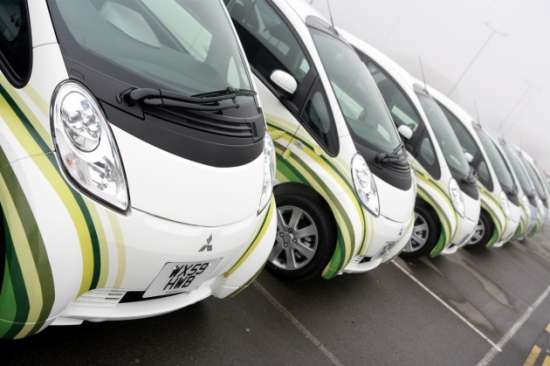
Representatives from Mitsubishi Motors North America, Inc., (MMNA), along with San Rafael Mitsubishi, conducted the very first fleet delivery of the all-new 100% electric-powered 2012 Mitsubishi i to the California Bay Area's City CarShare in a special ceremony held at the Green Vehicle Showcase located in front of San Francisco City Hall Plaza on Thursday, December 8 at 9:00 a.m.
City CarShare is a Bay Area nonprofit organization founded in 2001 with the help of several other local nonprofits and the cities of San Francisco, Berkeley and Oakland. Their mission is to promote innovative mobility options to improve the environment and the quality of life in the Bay Area. By providing short-term access to cars, City CarShare is reducing traffic congestion, parking problems and dependence on oil while promoting cleaner air and quieter streets.
"We are very pleased to introduce the all electric Mitsubishi i into our fleet. This vehicle brings us one step closer toward our goal of having 50% of our fleet run on alternative fuel as part of our mission to decrease carbon emissions in the Bay Area," said Rick Hutchinson, CEO, City CarShare.
Numerous fleet orders have already been placed for the innovative, environmentally-friendly and fun-to-drive Mitsubishi i by a wide variety of organizations - multinational corporations, municipalities large and small, major utilities and nonprofit organizations - from New York to Hawaii.
"We thank the Bay Area's City CarShare for being the first fleet recipient of our innovative 100% electric-powered vehicle," said Yoichi Yokozawa, President and CEO of Mitsubishi Motors North America, Inc. (MMNA). "City CarShare's stated goals are to help promote modes of personal transportation that help improve the environment while reducing noise pollution as well as fossil fuel dependence, so the 2012 Mitsubishi i is the perfect vehicle to help achieve this nonprofit's ambitious mission."
The 2012 Mitsubishi i is the first of several new advanced, alternative-fuel production vehicles that the Japanese auto manufacturer plans on bringing to the North American market in the next few years.
Subscribe to:
Posts (Atom)