Thursday, December 8, 2011

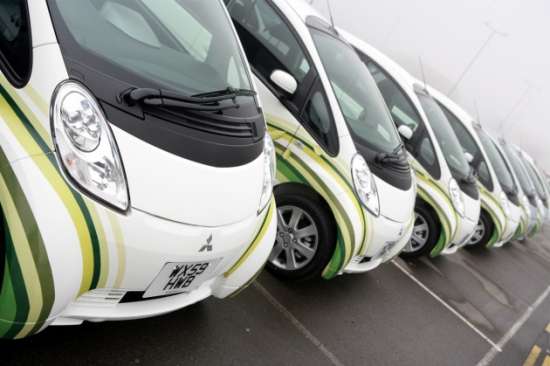
Mitsubishi Makes First Delivery of 2012 Mitsubishi i-MiEV to City CarShare


Representatives from Mitsubishi Motors North America, Inc., (MMNA), along with San Rafael Mitsubishi, conducted the very first fleet delivery of the all-new 100% electric-powered 2012 Mitsubishi i to the California Bay Area's City CarShare in a special ceremony held at the Green Vehicle Showcase located in front of San Francisco City Hall Plaza on Thursday, December 8 at 9:00 a.m.

City CarShare is a Bay Area nonprofit organization founded in 2001 with the help of several other local nonprofits and the cities of San Francisco, Berkeley and Oakland. Their mission is to promote innovative mobility options to improve the environment and the quality of life in the Bay Area. By providing short-term access to cars, City CarShare is reducing traffic congestion, parking problems and dependence on oil while promoting cleaner air and quieter streets.

"We are very pleased to introduce the all electric Mitsubishi i into our fleet. This vehicle brings us one step closer toward our goal of having 50% of our fleet run on alternative fuel as part of our mission to decrease carbon emissions in the Bay Area," said Rick Hutchinson, CEO, City CarShare.

Numerous fleet orders have already been placed for the innovative, environmentally-friendly and fun-to-drive Mitsubishi i by a wide variety of organizations - multinational corporations, municipalities large and small, major utilities and nonprofit organizations - from New York to Hawaii.

"We thank the Bay Area's City CarShare for being the first fleet recipient of our innovative 100% electric-powered vehicle," said Yoichi Yokozawa, President and CEO of Mitsubishi Motors North America, Inc. (MMNA). "City CarShare's stated goals are to help promote modes of personal transportation that help improve the environment while reducing noise pollution as well as fossil fuel dependence, so the 2012 Mitsubishi i is the perfect vehicle to help achieve this nonprofit's ambitious mission."

The 2012 Mitsubishi i is the first of several new advanced, alternative-fuel production vehicles that the Japanese auto manufacturer plans on bringing to the North American market in the next few years.

Hybrid and Plug-In EVs to Surpass 5% of U.S. Vehicle Sales by 2017


The early market for electric vehicles is proving that demand for the vehicles exists across the globe. The combination of consumer purchase incentives, rising fossil fuel costs, and exciting new vehicle models is fueling a strong early adopter market. Production of electrified vehicles is gearing up all over the world, and automakers are planning to launch an increasing variety of new models over the next few years. In recent weeks new electric models have been officially launched, after months of advance publicity, by both Chevrolet (Spark EV) and Honda (Fit EV). Automakers around the world will introduce dozens of new models over the next few years, fueling consumer interest and increasing sales of electric vehicles as a percentage of total auto sales.

According to a recent report from Pike Research, hybrid electric vehicles (HEVs) and plug-in electric vehicles (PEVs) combined will represent 3.1% of worldwide auto sales by 2017. Thanks to higher penetration rates in the United States, HEVs and PEVs will account for 5.1% of total U.S. vehicle sales in 2017.

"The PEV market is anticipated to miss many of the targets set by governments because vehicle programs have not been launching as rapidly as expected even a year ago," says senior analyst Dave Hurst. "Those targets aside, though, the EV market will grow at a rapid clip in the next six years -- at a rate of nearly 20% a year, compared to fewer than 4% for the worldwide market for vehicles of all kinds."

Overall, the Asia Pacific region is expected to experience the most rapid growth in the number of plug-in electric models, followed by Europe and North America. There will be 26 models of PEVs available in Asia Pacific by the end of 2011, compared to 23 models in Europe and ten in North America. However, strong demand for hybrid electric vehicles (HEVs) in North America will lead to the availability of 40 models by the end of 2012, versus 14 HEV models in Asia Pacific.

Within the United States, the PEV market is currently led by two key models, the Chevrolet Volt and Nissan Leaf. However, Pike Research anticipates that Ford's model diversification and recharging equipment strategy will shake up the market. Ford will likely take the market lead by 2017 with 23.6% PEV market share. Toyota (with a plug-in version of its popular Prius) and General Motors will likely find themselves fighting for second with 21.1% and 20.7% market share, respectively. Interestingly, startup Tesla's dealer strategy and high price point are expected to limit its market access. Still, Pike Research expects market share for the startup to grow to 4.6% by 2017 from 2.2% in 2011.

5 Million Electric Cars Will Power Homes, Grid by 2017


The number of electric vehicles able to power buildings and feed the power grid will grow from 100,000 today, to more than 5 million in 2017, according to a new study by Pike Research, a market research firm for the clean technology industry.

The prospect of a power grid made more stable and efficient by millions of EVs connected to homes, and thus the power grid has been a much vaunted secondary benefit of widespread adoption of electric cars. So far it’s not even close to happening. But, the researchers predict, it will by the middle of the next decade after continued exponential EV adoption, especially in commercial fleets.

As of now there has been exactly one commercial test project of V2G possibilities. That was headed by the University of Delaware and PJM Interconnection, and it concluded in 2010 (PDF report). The data from that project will shape future plans for commercialization, Pike research predicts.

There are a few obstacles and disincentives for utilities to connect cars to the power grid, according to the report. One hitch to growth right now is that one Nissan Leaf on a block is not enough to interest a power company in building out vehicle-to-grid connections in an area. There needs to be a cluster of EVs close enough to each other to tempt a utility. Fleet vehicles, like these electric delivery trucks, are the best candidates for a cluster of battery power storage the researchers posit.

While EVs could take on excess power from utilities, something they certainly want, utilities could potentially lose money on power served to homes with vehicle to grid capacity. If car batteries are able to take and store the cheaper power offered in off hours, the car itself could be a cheaper power source for a home or business during the expensive peak daytime hours.

Just how an electric car, a home, and the power grid will all interact is still far from sorted out. ”Vehicles will compete with traditional generation sources as well as with emerging technologies, such as stationary battery storage,” according to the report. What might turn out a more popular relationship between the next generation of car and power grid is for the car to help the grid more than the power the home it is connected to. Utilities and automakers are both keen on using EVs for frequency regulation, accepting more power for a faster charge when more power is available, and taking less when demand is straining the overall grid. ECOtality, an EV charger company, announced today a plan to use cars on their charging systems to help Maryland utility, Silver Spring Power Co. regulate their supply and demand through a smart-grid EV connection that shifts EV charging to off-peak hours if needed.

Finally, the report authors note that carmakers don’t benefit from selling an electric car that can give back to the grid as compared to a car that can just charge up as normal. So until consumers clamor for that extra service, the feature is likely to be limited to costly retrofits or special orders, rather than standard with all new EVs, further limiting adoption.

Source: Pike

Holden Volt Charges Into Australia By Late 2012


The cutting-edge Holden Volt electric vehicle with extended range mode will establish an entirely new segment in the Australian market when it launches late in 2012. The five-door, four-passenger Volt is designed to provide the benefits of an electric vehicle without the range limitations usually associated with electric vehicles.

“The Holden Volt can be the only car you need to own,” said Mike Devereux, Holden Chairman and Managing Director.

“The Volt is a true game changer for Holden and the entire industry. It promises to revolutionise the way people view electric vehicles with its world-beating drivetrain, progressive styling and outstanding safety.

“The Volt also signals the start of a new era for Holden as we take a leadership position on technology and sustainable motoring. This is an incredibly exciting vehicle.”

Source: Holden

Wednesday, December 7, 2011

Mitsubishi announces 1,000th i-Miev in Norway


Mitsubishi have announced the delivery of Norway’s 1,000th i-MiEV electric vehicle, significantly more than the original annual estimate of 400. In Norway, electric car purchasers can receive substantial incentives and since the launch of the i-MiEV in Norway in January 2011 it has maintained the top spot in total sales volume of compact vehicles.

Compared to petrol cars the i-MiEV is extremely inexpensive to operate. There is no road tax and it costs as little as USD$1.50 to charge the car overnight, which gives it enough juice for around 93 miles. With petrol prices in Norway the most expensive in the world @ USD$9.73/US Gallon, that’s potentially an enormous saving.

GM near possible Volt battery fix


General Motors Co is closing in on a package of proposed fixes for the Chevrolet Volt battery pack that engineers believe would eliminate the risk of a fire being triggered days after a crash, two people with knowledge of the situation said Tuesday.

The proposed repairs under consideration would involve laminating circuitry in the Volt's 400-pound battery pack, reinforcing the case surrounding the lithium-ion battery and better protecting the coolant system from leaks in a severe crash, the sources said.

GM has acted quickly to tamp down concerns about the Volt after U.S. safety regulators opened an investigation into the fire risk from the plug-in hybrid's battery pack last month.

A relatively quick repair that could be completed for owners at GM dealerships could spare the automaker the cost and reputation damage from a more involved safety recall.

GM has made the Volt the symbol of its determination to seize a leadership position in fuel economy and green technology. The Volt has a gas-powered 1.4-liter engine to provide additional range after it has run about 40 miles on its battery.

Engineers at the No. 1 U.S. automaker are expected to update senior management by the end of the week on what could be a relatively low-cost way to fix the more than 6,000 Volts now on U.S. roads, one of the sources said.

The cost of the fixes under consideration could total less than $9 million for GM -- or about $1,000 per Volt, the sources said. That could include the labor for repairs at dealerships, but the costs could rise if U.S. regulators press for a more involved solution, the sources said.
The National Highway Traffic Safety Administration opened a probe of the Volt's battery pack last month. NHTSA, which has the power to review proposed safety fixes by automakers, had no immediate comment.

GM spokesman Rob Peterson said engineers were still working on the problem. "To the best of my knowledge, we're not discussing exact solutions at this point," he said.

A lithium-ion battery pack in a Volt that went through a crash test in May caught fire three weeks later at a NHTSA test facility in Wisconsin.

In lab tests completed in late November by U.S. regulators, a second Volt pack began to smoke and throw off sparks while a third battery pack caught fire a week after a simulated crash.
GM executives have said the Volt's battery pack would be safe during and immediately after any crash and that problems were not linked to any flaw in battery cells supplied by South Korea's LG Chem Ltd.

GM says the Volt is safe and has rushed to reassure early buyers with what it has called a "white-glove" approach.

The automaker offered loaner cars to the more than 6,000 Volt owners while the safety investigation continues.

GM Chief Executive Dan Akerson raised the ante days later by vowing to buy back any Volts if consumers had concerns, an unusual if not unprecedented step.

Akerson told Reuters last week that the U.S. automaker might need to redesign the Volt battery. GM officials have said the engineering fixes would likely stop far short of a clean-slate redesign for the vehicle's most expensive component.

An influential insurance group, Insurance Institute for Highway Safety, said on Monday it had no plans to strip the Volt of its "five-star" safety rating. The ratings from the group are closely watched by consumers and often used in automakers' marketing.

NHTSA also has no plans to change the Volt's "five-star" safety rating, another key resource for consumers.

The plug-in hybrid costs $40,000 before a $7,500 federal tax credit. GM has been losing money on the vehicle because of the Volt's high development costs and low sales volume.

The Obama administration has been a strong proponent of electric vehicles like the Volt and set a goal of getting one million battery-powered vehicles on the road by 2015.

Tuesday, December 6, 2011

Nissan Leaf Sales Expand into 7 more U.S. States


Days before the one-year anniversary of the world's first Nissan LEAF delivery on Dec. 11, Nissan expands availability of the all-electric LEAF into new U.S. markets. After one year and 20,000 global deliveries, the Nissan LEAF remains the world's only all-electric car for the mass market.

Today, Nissan has re-opened reservations and has begun taking orders from the general public for the 2012 Nissan LEAF in Delaware, Indiana, Louisiana, Nevada, Ohio, Pennsylvania, and Rhode Island. Deliveries of the LEAF, enriched for the 2012 model year with additional standard equipment including quick charging and cold-weather features, will take place in these key markets beginning in spring 2012.

"Nissan LEAFs have been on the U.S. roads for one year now, and thousands of drivers have become living proof that a 100-percent electric, zero-emissions vehicle fulfills the daily needs of drivers from all walks of life," said Brian Carolin, senior vice president, Sales and Marketing, NNA. "We are seeing already-strong interest in the LEAF continue to grow across the country. This market expansion brings us one step closer to true, nationwide availability."

With this new wave of availability, Nissan LEAF is now available for order in 30 states, including Washington, D.C. Nationwide, 50-state ordering will be available by March 2012.