Saturday, April 3, 2010

RaceAbout Association unveils AWD Electric X-Prize car in Helsinki


RaceAbout Association has unveiled its electric RaceAbout (ERA) at the Cable Factory in Helsinki. The Finnish vehicle is a contender for the X-Prize award. The four-wheel-drive electric sportscar is now beaded to the U.S. for this month’s “shakedown stage” of the Progressive Automotive X-Prize competition.

Said to be "paving the way for creating an electric car industry in Finland", the majority of the 60 companies and institutions involved with the project are from that Nordic country. One of the technologies involved are the direct-drive in-board electric motors the ERA has powering each wheel. The design, developed specifically for electric vehicles by Lappeenranta University of Technology and also shared by Valmet's EVA concept, allow builders to forgo the use of a mechanical gearbox. No power or torque figures are provided in the technical data for the car.


Renault leads calls for KERS return to Formula One


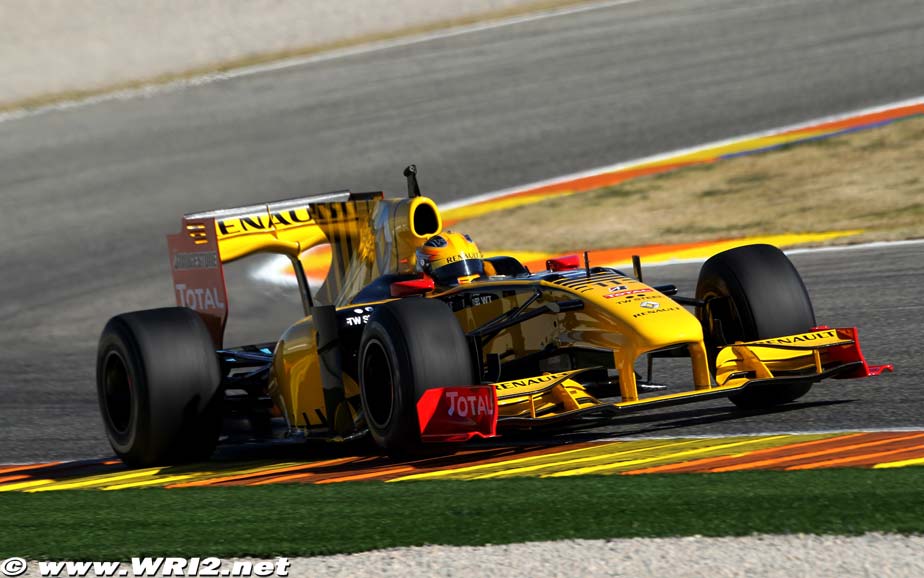
Renault is leading calls for rival teams to end resistance to Kinetic Energy Recovery Systems (KERS) returning to Formula 1 next year, because it believes such a move will benefit the sport hugely.

Opinions are currently divided between team principals about the potential return of KERS in 2011, with talks in a Formula One Teams' Association (FOTA) meeting at Sepang on Friday proving inconclusive.

However, Renault thinks that those outfits sceptical about getting it back should think more about what is best for F1 in general.

Team boss Eric Boullier believes that not only will a KERS return improve the sport's environmental considerations at a time when there are calls for it to be more 'green', but it will also help the racing if, as is hoped, its power output and use is increased from the limits imposed last year.

"Renault is aiming to have KERS back in 2011 because for us there are many interests in having this," Boullier said.

"First of all we already have the system. We have spent the money to develop KERS [for 2009], so to not use it any more is a bit of a waste of money.

"The second thing is that we do believe for the Renault car manufacturer there is a strong interest in using this technology regarding the development of hybrid technology in road cars. It also helps pass on the message that F1 is technological and environmentally friendly, which is a good message.

"On top of this, the reason we are asking for is the system to recover more energy - more than the 400KJ than the previous generation - is because it can become part of the show as well. It will clearly be an advantage to have KERS as well, and it can help overtaking."

Renault and Ferrari are the two teams pushing hardest for a KERS return for 2011, but there is resistance from a number of other teams who may feel that their own units will not be as competitive under the new more powerful limits – which could allow up to 800KJ of energy to be stored.

To counter such concerns, Boullier believes there was a chance that his team's supplier Magneti Marelli could make units available to every team – and even as a last resort the possibility of a standard supplier. There is also talk of imposing a cap on development and running costs so as not to start a spending war.

Boullier added: "We support the idea of KERS, and we can also help other teams and manufacturers who cannot get it. But now it will be a big discussion and a tough debate between the teams.

"As a manufacturer we need to have some deeper talks, because if KERS has to be back it must be a tool that every team can use. We will not run a KERS on our own, but we will support strongly an idea to propose KERS for every team because we do believe it is fitting for F1."

Friday, April 2, 2010

Mitsubishi Targets MiEV Starting Price Below $30,000 in US


Mitsubishi Motors North America Inc.is hoping to bring its first electric vehicle to market for under $30,000 before federal tax credits, company officials say at the auto show here today.

The MiEV small car is due to go on sale in the U.S. in 2011. The ballpark price is similar to what buyers will pay for the car in Japan.

Mitsubishi Motors Corp. Wednesday announced it was cutting the MiEV’s price in Japan, reportedly from ¥4 million ($42,612) to ¥2.8 million ($29,828), including tax credits.

“We’re targeting sub-$30,000 for the U.S. when it launches,” MMNA spokesman Maurice Durand says of the iMiEV following Mitsubishi’s press conference at the show.

The MiEV went on sale at retail in Japan today, and Durand says it will launch in Europe this summer.

The i-MiEV’s price cut in Japan came one day after Nissan Motor Co. Ltd. announced retail prices for its Leaf EV in the U.S., which goes on sale late this year, for $32,780. With a $7,500 federal credit, and a $5,000 EV credit offered by the state of California, the Leaf could cost buyers as little as $20,280.

Durand says many details of the MiEV’s U.S. retail launch still need to be worked out, including what company will supply and install the car’s home-charging units. MMNA is talking with several companies about the chargers.

AeroVironment Inc., supplier of the home charger for the Leaf in the U.S., recently told Ward’s its charger is compatible with any forthcoming EV, because its meets SAE standard J1772.

Thursday, April 1, 2010

Formula One Teams to discuss return of KERS


The potential return of Kinetic Energy Recovery Systems (KERS) to Formula 1 for 2011 is set to dominate the agenda of a meeting of team principals in Malaysia later today.

The Formula One Teams' Association (FOTA) is holding a get-together this evening to discuss the lessons of the first few races, and begin evaluation of improvements that could be made to the sport to improve the show.

Although some of the talks are expected to revolve around technical changes to the cars, sources suggest that one of the main areas of focus to help improving overtaking will be in getting KERS back on the cars.

The green technology was abandoned at the end of last year when teams agreed amongst themselves not to run the devices for 2010, because of the vast expense in successfully developing it. The use of the system remains in F1's technical regulations, however.

The teams will look at all options for a KERS return in 2011 - ranging from a standard supplier to freeing up the technology totally. Teams will also look at exactly how much, or how little, power the KERS should have.

The momentum behind getting KERS back has been increased because of the difficulties that drivers have faced in overtaking this season - and providing a push-to-pass system once again would help with the racing.

There is also a high chance that revisions to the cars already in the pipeline will help the situation further. Double diffusers have already been banned for 2011, which should cut downforce levels, while it is understood that the FIA is looking at increasing the width of F1's rear tyres to 18 inches for next year - up from the 13 inches of the current generation.

This will produce much more mechanical grip, which should be another factor in helping boost the racing spectacle.

Government to buy first 100 U.S-built plug-ins


The first customer for the Chevrolet Volt also happens to be its largest investor — the Obama administration.

The White House said Wednesday that the government will “purchase the first 100 plug-in electric vehicles to roll off American assembly lines” before the end of the year.

The Volt, which GM describes as an extended-range electric vehicle, is the only model that fits that description. GM began building its first production Volts at the Detroit-Hamtramck plant on Wednesday.

President Barack Obama has set a target of putting
1 million plug-in hybrids on U.S roads by 2015. In announcing a new plan for offshore drilling Wednesday, Obama also said the government would double its purchases of hybrid vehicles to 5,000.

“We’re going to lead by example and practice what we preach: cutting waste, saving energy and reducing our reliance on foreign oil,” Obama said.

But one year ago, Obama’s auto task force questioned whether GM was spending too much to develop the Volt, saying “it will likely be too expensive to be commercially successful in the short-term.”

GM has said it will build a few thousand Volts in its first year, with output eventually ramping up to 60,000 annually. The Volt’s battery pack offers an all-electric driving range of 40 miles, with a gas engine that extends the range to that of a typical vehicle.

New electric vehicle has Japanese queuing


Japan's first mass-market electric car went on sale in showrooms Thursday as the futuristic technology becomes more affordable amid a burgeoning price war.

The four-seater bubble-shaped i-MiEV from Mitsubishi Motors Corp., Japan's fifth-biggest automaker, costs 2.8 million yen ($30,500) after government incentives are figured into the price of 4 million yen ($43,000).

Proud i-MiEV buyer Chitoshi Okunuki, 72, placed an advance order at a higher price in August and was thrilled at Mitsubishi's decision Tuesday to cut the price by 620,000 yen ($6,700). That came the same day rival Nissan Motor Co. announced it will take orders for its own electric car, the Leaf.

"I'm so happy," said Okunuki, who runs a convenience store, during a visit to a Mitsubishi showroom. "It's so quiet, and there are no emissions."

With concerns about the environment growing, electric vehicles — long an expensive, experimental technology used in Japan mainly by government-related groups — are suddenly all the rage.

The key to their becoming widespread is certain to be pricing, and that is likely to continue a downward slide as competition intensifies.

Nissan, Japan's No. 3 automaker, said the Leaf, due to go on sale in December, will cost 3.8 million yen ($40,500) but that will fall to 3 million yen ($32,000) with government incentives.

The Leaf gets even cheaper in the U.S. at just over $25,000 because of a $7,500 federal tax credit for electric vehicles.

Mitsubishi says it got about 2,000 advance orders in Japan for the i-MiEV, which stands for Mitsubishi innovative Electric Vehicle. It is based on the company's gasoline-powered "i" minicar.

Also this week, Chinese automaker BYD started retail sales of its new electric car, the F3DM, for the equivalent of $25,000.

Ford Motor Co. is planning an all-electric Focus compact car for sale in late 2011.

Toyota Motor Corp., the world's biggest automaker, is planning an electric car for 2012. Prices have not been announced, but they are likely to be more within reach than the two-seater Tesla Roadster's $100,000.

China's first electric vehicle charging station put into service


China's first large electric charging station for electric vehicles—the Tangshan Nanhu EV Charging Station – was put into service on March 31. The station was built by the North China Grid Company, Ltd. in accordance with government-mandated design criteria.

The Nanhu Charging Station, with investment capital of more than 19 million yuan, is equipped with two large DC chargers, eight medium chargers and 10 charging spots and is able to charge 10 electric vehicles simultaneously.

On March 31, North China Grid and Tangshan municipal government signed a strategic cooperation agreement to promote the construction of electric vehicle charging facilities. Tangshan has put 19 electric vehicles into service on two demonstration electric bus routes. In addition, North China Grid has concluded agreements with five cities in northern Hebei province—Tangshan, Zhangjiakou, Qinhuangdao, Langfang and Chengde – to build three charging stations and 100 charging poles in 2010.