Wednesday, August 18, 2010
Fullycharged Episode 6
This weeks episode of Fullycharged is a round up of some interesting electric vehicles Robert Llewellyn has had a look at over the last few months. Robert gives us a quick look at the new Toyota Auris Hybrid that started production in the UK in June then gives us a quick glimpse of the Electric Radical SRZero Sports car powered by the Evo Electric Motors we discussed recently.
There's also a brief look at the all wheel drive electric Range Rover we reported on back in July and a mini-bus / van EV conversion

Tuesday, August 17, 2010
Students build World Record 300 MPG Electric Car out of Indy Car
A group of high school students from the DeLaSalle School in Kansas City, Mo., and their mentors, including engineers from Bridgestone Americas' Technical Center in Akron, Ohio, have just concluded tests on a student-built electric car at Bridgestone's Texas Proving Grounds – and may have set a world record for efficiency.
The all-electric vehicle was built as a class project under the direction of instructor Steve Rees. With the help of automotive mentors, the students have created a plug-in electric car based on the chassis of a 2000 Lola Indy Car.
The students have developed a driveline, electric propulsion system and full, ultra light-weight aerodynamic body. The car, which is mounted on Bridgestone Ecopia EP100 tires, showed remarkable results in testing— test runs reported efficiency levels that would be the equivalent of more than 300 miles per gallon.
Steve Rees is currently petitioning Guinness World Records to consider the students' accomplishments as a new world record.
Bridgestone

Wrightspeed hints at 1000 hp All Wheel Drive Hybrid Supercar / Truck
In an extended interview with Katie Fehrenbacher over at Earth2Tech Ian Wright, posing as yet another founder of Tesla Motors, has publicly laid out his plans for a 1000 hp AWD series hybrid - extended range EV supercar that 'might' be ready in 12 - 18 months, or was it going to be a light truck?
Coming from Wrightspeed, a five year old start up car company that has built only a single EV conversion out of an Ariel Atom chassis powered by an AC-150 powertrain sourced from AC Propulsion, those sound like bold claims.
In part two of the interview it gets even more interesting when Wright starts talking about reducing the weight of a 250 hp electric motor from 110 lb down to only 40 lb. Something smelt like BS so I decided to look into it in a bit more depth.
What we're confident Ian Wright is referring to are motors, in fact the entire powertrain, from a UK company called Evo Electric. Their series hybrid system was featured in the Lotus Evora 414E Hybrid concept car which was said to be powered by only a 35 kW, 1.2 litre, three cylinder as a plug-in series hybrid but with 300 kw worth of electric motors driving the rear wheels.
Most recently an Electric Radical SRZero Sports car, currently being driving by students from Imperial college London (Evo Electric is a company spun off from Imperial) up the Pan-American Highway from Argentina to Alaska, features two of the same Axial Flux electric motors and just yesterday Reynard published a photo of their new sports car with a single Evo Electric motor almost driving the rear wheels.
While Evo Electric has recently sent out a press release claiming they are 'pushing the boundaries of electric motor technology' we think they should perhaps rephrase that. They're certainly pushing the boundaries of something but perhaps that's credibility. The motors in question are Axial Flux BLDC permanent magnet synchronous motors. One of the advantages of axial flux, which use a disc rotor, over radial flux, which use a barrel shaped rotor, is that motor torque in a AF motor is proportional to the motor radius cubed. In a more common radial flux motor torque is proportional to the motor radius squared. Quite a difference.

The AF-140 used in all these vehicles, With a Diameter of 380 mm and only 115 mm thick, mounts in-board on the chassis with one directly driving each rear wheel. The company head-lines peak power figures of 167.5 kw (227.8 hp) and 600 Nm of torque for each motor. It seems to be EV industry standard now to quote only peak outputs, after-all, the Tesla motor is actually rated at 50 Kw continuous yet they publicize only the 185 kw peak power figure. We think Evo might be pushing it a bit too far in their case.
Industrial electric motors are routinely quoted for peak and continuous power output. Continuous being self explanatory and peak being how much power output can be obtained before the temperature rise de-rates the motor, usually over approx 10 - 20 minutes. The company literature for the AFM-140 is quoting peak torque outputs in the microburst range of 18 - 60 seconds. We can only presume they're doing the same with peak power output.
Ian Wright was close when quoting the power to weight ratio for these motors, but they weigh 40 kg each, not 40 lb. The method used to calculate power density, we think, is pushing the boundaries of credibility too. A 17' diameter wheel turns something in the region of 1500 rpm at 100 mph. The Evo Axial Flux motors are in-board wheel motors, that in direct drive configuration, will therefore only ever see a maximum around 1500 rpm yet the base speed where they achieve maximum power is 5000 rpm. Torque x rpm / 5252 = hp so they're a fair way short of maximum claimed power at any usable road speed which is more likely less than 25% of base speed.
Maximum Rpm isn't necessary to get max torque from electric motors, as we all know. Electric motors have 100% torque from zero rpm, the main reason why they are so blisteringly fast off the line. With two Evo motors in the back of a sports car, such as the Radical SRZero, you'll have 600 Nm from each (for 18 seconds at least) giving the car a peak of 1200 Nm at the rear wheels. That does sound impressive but it's less than half that of a Tesla.
The 3 phase AC induction motor in the Tesla Roadster Sport puts out 400 Nm at the motor shaft. Multiply that by the 8.25:1 reduction gear ratio and we get 3300 Nm at the rear wheels. It's equivalent to the torque multiple most cars get in first gear, but in the Tesla it's available at any speed up to 125 mph. Sure, there are power losses through the gear box, but nothing like enough to knock it down by more than half.
So while Wrightspeed's 1000 hp Hybrid monster sounds good in a pit lane chat, even with four motors and All Wheel Drive, it will still have less torque off the line than a Tesla Roadster and will need to reach over 300 mph to make full power.
This, of course, is exactly why Mercedes and Audi have added reduction gearboxes to the in-board wheel motors in their AWD EV Sports cars. It also has alot to do with why Audi thought they could get away with a bit of BS of there own when they inflated a total of 682 Nm (501.5 ft/lb) across all four motor shafts into 4500 Nm (3319 ft/lb) at the press release. Audi ignored accepted auto industry standards and quoted torque for the e-tron at the wheels, which is after the torque multiplication of the reduction gearboxes.
If Wrightspeed add reduction gears then all the above numbers get thrown out the window, but the trade off is 20 - 30% power loss through the mechanical transmissions, in both acceleration and more importantly in regeneration, resulting in a reduction of the vehicles potential range by 20 - 30%. A gearbox also adds approx 20 kg to each motor which in this case means a 50% increase in weight and resultant reduction in power density.
There are direct drive in-wheel motor designs being developed at the moment that are specifically designed to work to a maximum of 1500 rpm. These fall within the US Department of Energy’s realistic targets for 2015 and 2020 (1.3 and 1.6 kW/kg, respectively), and not hyperbole figures like 5 kW/kg peak power density as quoted by Evo.

Monday, August 16, 2010
Capstone to supply microturbine series hybrid system to TATSA for Bus Application
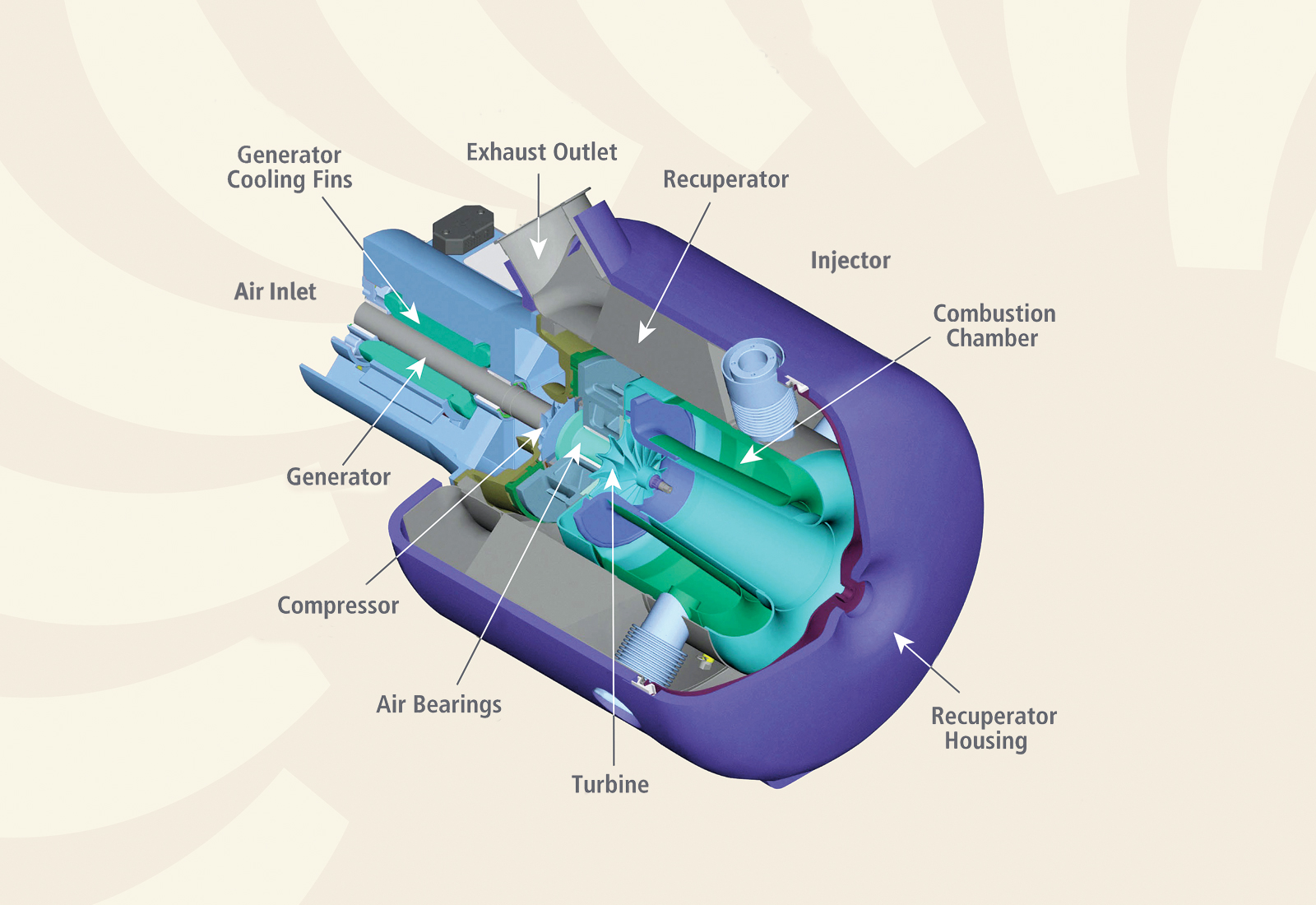
Capstone Turbine Corporation announced today it has initiated a demonstration project with TATSA, an Argentine bus manufacturer that will use a Capstone hybrid electric drive system -- which features a C65 microturbine -- as a clean, efficient range extender for a transit bus.
This will be one of the first applications of Capstone's new Drive Solution in a transit bus. In addition to a natural gas 65-kilowatt microturbine, Capstone will provide the series hybrid drive solution, including drive motor, inverter system, and vehicle power interface module. The Capstone Drive Solution offers significant advantages over more traditional prime movers because it achieves high efficiency with alternative fuels while maintaining ultra-low emissions.
"We are pursuing eco-friendly drive train solutions for our range of buses and recognize the benefits the Capstone microturbine system offers our customers," said TATSA CEO Vicente San Salvador. "The demonstration project is for a transit bus operating on natural gas. We have a unique opportunity to manufacture a high efficiency, low emissions bus and then have our parent company, Grupo Plaza, validate the performance and financial benefits in actual transit operation."
The Capstone Drive Solution is suitable for a range of electric vehicle applications, from passenger cars to Class 8 trucks, delivery vehicles, busses, as well as construction equipment and marine applications. The Capstone Drive Solution makes it easy for vehicle, equipment manufacturers and boat builders to integrate Capstone C30 and C65 microturbines into a series hybrid electric vehicle or vessel.
The inverters and traction motors are mobile-hardened and engineered for these demanding applications.
"We are working with vehicle OEMs and boat builders that want to improve efficiency and reduce emissions of their products," said Jim Crouse, Capstone's Executive Vice President of Sales and Marketing. "This project with TATSA demonstrates that transit companies are seeking new technologies to meet increasingly stringent emissions requirements and to reduce the carbon footprint of their fleets."
GM working on a Corvette Hybrid?

(click to enlarge)
Last week, the rumour-mill was grinding away with speculation that the next generation Chevrolet Corvette would receive a mid-engined layout. This week, GM has officially denied it would happen, with its vice president of global vehicle engineering, Karl-Friedrich Stracke, stating specifically, “there is no mid-engine in the plans.”
Speaking with industry publication, Autoweek, Stracke said “The rumors and speculation about the Corvette are just that.”
He also quashed rumours of a possible V6 version, saying that GM is not testing anything of the sort. Hybrid power is a very different story, though. When questioned as to whether a hybrid would form part of the next Corvette’s plans, Stracke stated, “that is an interesting idea.”
Mentioning the fact that Porsche has investigated hybrids for its entire line-up, it’s clear that GM is also thinking along similar lines.
“You could keep a normal powertain configuration for a small amount of very excited car enthusiasts,” Stracke said. “And turn 80 to 90 percent of your sports-car portfolio to hybridization.”
Reynard Inverter sports car EV version in development

(click to enlarge)
THE Reynard Inverter sports car, so-called because it produces enough downforce at 160km/h to theoretically drive upside-down on the ceiling of a tunnel, has passed the British Individual Vehicle Assessment (IVA) to make it road-legal.
A brainchild of race car constructor Dr Adrian Reynard and race engineer Andre Brown, the 445kg Inverter is claimed to be capable of producing 1180kg of downforce and sustaining more than 3g in corners on road tyres.
In the UK, a track-ready Inverter powered by a 132kW 1000cc Honda Fireblade engine and with a top speed of 217km/h can be had for £35,000 ($61,000). A 147kW, 1340cc Suzuki Hayabusa engine is also available, with further versions powered by car engines and even an EV under development.
A franchise system is being considered to enable third parties to manufacture the cars internationally. One of the aims of the Inverter project is to become a “virtual car company” with manufacture and assembly of the vehicles outsourced so that the company can focus on design and development.
Significantly, on page 13 of the company’s brochure, they include the description of a 145kW Inverter EV with a 240km road range, dropping to under 50km under race conditions.
The specs given are a 60 kWh Kokam battery powering a Evo Electric Axial Flux PM DC motor via a Zilla Z1k controller. Seeing as the Evo motor is 3 phase BLDC and the Zilla only works on brushed DC motors we'd say the Reynard EV version was in the VERY early stages of development. They are however open to partners willing to assist. Such a technical gaffe is ironic given the cars name.
Dr Adrian Reynard built his first racing car in 1973 as a student. In 1979, he drove cars of his own design to win the European and British Formula Ford 2000 championships. The race car designer and builder went on to become a founder of the BAR Formula 1 team. To this day, he continues to provide consultancy and test facilities to motorsport.
Andre Brown, who met Mr Reynard through the Motorsport Industry Association, has an Engineering degree from Bath University and founded his own company, Hartham, for the purpose of race car design and development.
Mr Reynard’s interest in low-cost manufacturing and a desire to produce a road car led him to team up with Brown to design a road-legal sports car capable of competing in the 750MC Bikesports championship that would be easy to construct using automated, computerised and robotic techniques.
85% Cheaper Battery for Electric Vehicles

The new company, called 24M, has been spun out of the advanced battery company A123 Systems. It will develop a novel type of battery based on research conducted by Yet-Ming Chiang, a professor of materials science at MIT and founder of A123 Systems. He says the battery design has the potential to cut those costs by 85 percent.
The new company has raised $10 million in venture-capital funding, and about $6 million from the Advanced Research Projects Agency-Energy (ARPA-E), which will fund collaboration between the company and MIT and Rutgers University. A123 Systems will work closely with the new company, and owns stock in it. The name stands for "24 molar," referring to material concentration levels that Chiang cryptically calls "technically significant" to the company.
One advantage of lithium-ion batteries--the kind used in laptops, and which will be used in a new wave of electric vehicles coming out starting at the end of the year--is that the electrode materials can store large amounts of energy. But the packaging required to handle that energy takes up a lot of space and adds cost and weight. "In a typical rechargeable battery, only half of it is actual energy-storing materials. The rest is supporting materials," Chiang says. "That's a problem I've been thinking about for years--how do you improve the efficiency of the design?"
Reducing the amount of materials isn't easy. To extract useful amounts of electric current from electrode materials, these materials have to be spread in very thin layers over sheets of foil, which take up a lot of volume inside the cell.
Fuel cells and flow batteries don't have this problem. The energy-storing material--a fuel such as hydrogen or a liquid electrolyte, respectively--can be flowed past a membrane, which makes it easier to get the energy out.
The problem with a fuel cell is that it can't be recharged by applying electrical current--you need to refill the fuel tank. That's fine if the fuel is widely available, but right now hydrogen can be hard to come by. Flow batteries require vast amounts of electrolyte because their energy density is low. "It's like managing a swimming pool full of corrosive liquid," Chiang says. As a result, flow batteries are not practical for cars.
As with fuel cells, the new battery can store large amounts of energy without also needing large amounts of supporting materials to extract it, Chiang says. Yet it retains the rechargeability and energy density of lithium battery electrode materials. The result is that the battery can store a relatively large amount of energy at low cost. But he's purposefully vague about the mechanisms involved, saying only, "The final version of the device will look very different from both a conventional battery and a flow battery."
Chiang says the new design could work with a range of battery chemistries. So far, he's developed a proof-of-concept device--which was needed to get the Arpa-e grant. But, he says, "there's a lot of work to do." He's setting a goal of five years to get the first systems out in the field.
Subscribe to:
Posts (Atom)