Showing posts with label Solar Car. Show all posts
Showing posts with label Solar Car. Show all posts
Monday, November 28, 2011
World Solar Challenge 2011 Overview [video]
WorldSolarChallenge.org have uploaded a 15 min overview of the 2011 running of the event starting at Scrutineering onto their Youtube Channel.

Wednesday, October 19, 2011
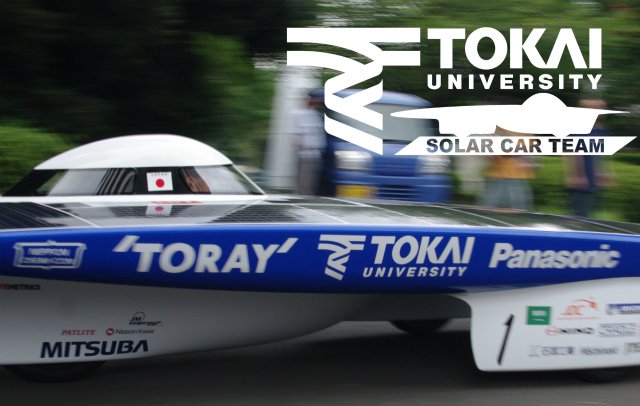
Tokai Uni wins World Solar Challenge

Tokai University has taken the World Solar Challenge after one of the tightest last days in the history of the race. After 3,000 km and four days, less than 30 minutes separated first and second place, with The Netherlands' Nuon team running a close second.
In a race disrupted by bushfires and rather unusually marred by a vehicle fire that somewhat crimped Team Solar Philippines’ style, the winners crossed the finish line at 1.05pm Darwin Time. Nuon is expected within another 40 minutes.
Today’s stretch to the last compulsory checkpoint at Port Augusta was highly competitive with the Dutch Team Nuon hitting the mark about 25 minutes after Tokai.
But Port Augusta to Adelaide turned in to a bit of a procession, with heavy traffic, a couple of road works and overcast skies impeding progress. The solar car averaged 100km/h on the final stretch, despite the challenging conditions.
Australia’s best-placed team is Aurora, currently placed fifth.
2011 Veolia World Solar Challenge
Day 5 - Thursday 20 October 2011
Provisional Results
1. Tokai University
2. Nuon Solar Car Team
3. University of Michigan
4. Ashiya University
5. Solar Team Twente
6. Aurora
7. Umicore Solar Team
8. UNSW Solar Team
9. Istanbul University
10. Stanford Solarcar Project
Tokai leads Nuon as competition hots up in World Solar Challenge
After nearly 2,500 kilometres just 40 kilometres separate the two leading cars in the
2011 Veolia World Solar Challenge. Team Tokai from Japan are approximately 160
kilometres from Port Augusta as they prepare to make camp, with second placed
Nuon approximately 200 kilometres from Port Augusta. Team Michigan is spending
the night in Glendambo some hundred plus kilometres behind.
Team Twente from the Netherlands is in fourth place for now just south of Coober
Pedy and involved in a close competition with Ashiya from Japan (5th) and Aurora
from Australia (6th) both in Coober Pedy – with only an estimated 20 kilometres
between them. Umicore from Belgium is in 7th place, with University of NSW in 8th
place, Istanbul University in 9th place just north of the South Australian border and
making up the top ten is Stanford University team.
All 37 teams are still participating in the race which now spans more than 1260
kilometres from the rear of the field in Ti Tree to the leaders. The top eight teams are
all within the South Australian border. Australia’s third team from TAFE SA reached
Alice Springs this afternoon at 4.40pm.
The Philippines team who suffered battery problems late yesterday were able to
repair their car SIKAT II in Tennant Creek yesterday and have travelled today on solar
power – they are optimistic they will still be able to reach Adelaide.
The stage is set for an exciting finish which could come down to the wire. The first
teams are expected in Adelaide tomorrow afternoon at the finish of timing near the
corner of St Kilda Road and Port Wakefield Road in Angle Vale and then at the
Ceremonial Finish and celebrations at Victoria Square.
Sunday, October 16, 2011
Catch up after bad luck at start World Solar Challenge [video]
Solar Team Twente has driven 633 kilometres on the first racing day and is now on sixth position in the World Solar Challenge. The great qualification session of yesterday lead to a pole position. Today at the start however, a blown motor controller lead to a delay. The controller could be replaced in 20 minutes. But every minute counts and the unpredictable traffic in Darwin made that the team ended up in a traffic jam. The team is recovering quickly, overtook 18 solar cars and reached a top speed of 105 kilometres an hour. The car functions perfectly and shows great stability.
During the first media stop at 317 kilometres from Darwin the team had already overtaken 15 cars and was in ninth position. Racing driver Barry Vree: “Now I know how a F1 driver feels when his car halts just after the start. Bad luck. But it’s a race and things can change. The car felt good and we had an average speed of 80-85 kilometres an hour. Overtaking so many competitors was great fun. Only in Adelaide, we’ll now the consequences of this mornings casualty.” The goal for today was to drive as far as possible in order to reach the leading cars.

At this moment, the team is in Dunmarra at 633 kilometres from Darwin. Team captain Siebe Brinkhof reflects on the first day of the challenge: “After a fantastic qualification yesterday, we had never expected what happened this morning. It was quickly shown though that excellence comes with practice: the team remained calm and the problem was fixed routinely. Now we’re awaiting the next challenge: surviving the Outback without our truck that carries the tents and our food. The truck is still at about 300 kilometres from Dunmarra due to a punctured tyre. But we’re close to a filling station and we have a camper, cars and sleeping bags. It’ll be alright. It’s a race and the challenge is fantastic and adventurous.”
2011 Veolia World Solar Challenge - Provisional Results
Day 1 - Sunday 16th October 2011
Top 5 Teams
1. Tokai University
2. Nuon Solar Car Team
3. University of Michigan
4. Aurora
5. Apollo Solar Car Team
Live Race Tracking
Saturday, October 15, 2011
World Solar Challenge begins in Australia

Thirty-seven teams from 20 nations have started racing in the Veolia World Solar Challenge from Darwin to Adelaide.
There were last-minute fears that three teams slated to begin the race - one each from India, Germany and Korea - would miss the start after they struck trouble.
Ultimately all vehicles got away from Darwin's State Square on Sunday, with Korea's "Green Maniac" car starting about an hour after the race favourite, Solar Team Twente from the Netherlands.
The teams are aiming to travel to Adelaide - more than 3000 kilometres away - using vehicles powered only by energy from the sun.
Event director Chris Selwood told AAP he was delighted by the start, even though he predicted some teams would probably not make it all the way to Adelaide without a little help.
"There have been a few tears at the end," Mr Selwood said.
"The Indians made it across the starting line, and that is magnificent.
"They managed to pass the safety standards, but in reality I am sure our officials will be not far behind them and at some stage asking them to put their car in their trailer and move forward to the next checkpoint."
Unlike at typical car races, vehicles in the World Solar Challenge set off one after another, with about a minute separating each entrant's start.
Some cars in the race can cruise above 100 kilometres an hour and get short bursts of speed above 150km/h, although for safety reasons officials brought in rules in 2007 to limit their power.
The competitors will travel down the Stuart Highway and it is expected the top teams could reach Adelaide as early as Wednesday afternoon, as long as the sunny weather continues during the trek.
The 2009 winner, Team Tokai from Japan, started fifth on the grid and soon took an early lead.
The first Solar Challenge from Darwin to Adelaide was in 1987 although it is not an annual event, and this year marked the 11th time the race has been held.
Friday, January 7, 2011
Sunswift Solar Electric Car Breaking the Guinness world record [Video]
News footage from the UNSW Sunswift team's record-breaking run at Nowra NSW where the solar car, IVy, became officially the world's fastest solar car with a speed of 88 km/h.
Thursday, January 6, 2011
Aussie Solar car breaks world speed record

An Australian car is officially the world's fastest solar-powered vehicle, racing almost 10km/h above the previous record.
The solar racer Sunswift IV - known as IVy - was designed and built at the University of NSW.
"We've beaten the record by 10kms (per hour) - it reached a speed of 88kms - and we think we can get it over 90kms," a UNSW spokesman told AAP on Friday.
Powered by silicon solar cells trapping energy from the sun, the IVy broke the official Guinness World Record in a time trial on Friday.
The previous record was 79km/h.
In a race in 2009 from Darwin to Adelaide, IVy hit a top speed of 103km/h and on Friday morning it unofficially broke the record several times in trial runs.
The official speed trial took place at the HMAS Albatross naval base at Nowra on the NSW south coast, with professional drivers Barton Mawer and Craig Davis at IVy's controls.
Vehicles attempting to break the speed record in the category are required to be powered only by solar cells.
IVy normally uses its cells to charge a 25kg battery, but this was removed for the record attempt.
At speed the car produces about 1,200 watts, roughly the same power as a household toaster.
Sunday, December 19, 2010
Sunswift to attempt to break world solar land speed record
Wednesday Test Run from UNSW Solar Racing Team on Vimeo.
The University of New South Wales (UNSW) Sunswift Solar Racing Team will attempt to break the world land speed record for a solar car next month.
The team's solar car, affectionately known IVy, is a $280,000 three-wheeled, hand-built, carbon-fibre machine which can reach a top speed of 115 km/h using just 1300 W, the same amount of power it takes to toast two slices of bread.
With nothing more than solar energy from photovoltaic cells (no additional power from a battery), the team expects the car to hit at least 90km/h, which would break the record by 11km/h.
At a recent test run at the Western Sydney International Dragway at Eastern Creek earlier this month Business team leader and driver Kristen Casalenuovo said the attempt would show just how quickly solar innovations are progressing.
"A lot of the things created within solar have been adopted with electric cars seen on the road," the photovoltaics PhD student said.
A Guinness World Book of Records official will attend the attempt at an airstrip at the HMAS Albatross near Nowra on the southern NSW coast.
The team’s world record attempt looks promising after they recorded a top speed of 115km/h during the 3000km Global Green Challenge from Darwin to Adelaide.
The Sunswift team need perfect conditions with no wind or clouds so the panels can generate maximum possible energy from the sun with minimal aerodynamic resistance.

Sunswift
Monday, December 13, 2010
BYD to kick start US business with K9 electric bus

Chinese battery and car maker BYD Co. plans to start test-marketing an all-electric battery car in the U.S. next year, after almost a year's delay, and is in talks with officials in Los Angeles to supply e-buses that could eventually lead to a manufacturing plant in the city, a senior company executive said.
Originally, the e6 vehicle was supposed to launch in the U.S. this year. The delay has been a setback for the global ambitions of China's auto sector, which wants to use electric-vehicle technology to close the distance with more-established global car makers.
The first electric bus from BYD has been codenamed K9 and maybe the first mass produced Chinese electric vehicle to be widely sold on American roads. The K9 series of buses may be produced in LA due to their size and the expense of shipping something as heavy as a bus, which would make great PR for China PLC as an investor in the American job market.
BYD already has plans to make LA its US headquarters and plans to initially hire around 50-150 workers for the project which is still on going.
The K9 was officially unveiled at the recent EVS25 electric vehicle show in early November, according to BYD statistics the K9 will be able to travel for 300km on a single charge, which reduces to 250km should the air conditioner unit be activated. On the charging front the batteries can reach 50% charge within 30 minutes, which should make the K9 a great option for a green thinking State like California.
Monday, March 29, 2010
4,548 MPG Achieved at 2010 Shell Eco-Marathon Americas

Extreme mileage was the goal this weekend on the streets of downtown Houston as 42 student teams competed in the 2010 Shell Eco-marathon Americas, a challenge for students to design, build and test fuel-efficient vehicles that travel the farthest distance using the least amount of energy. More than 400 students were on hand to stretch the boundaries of fuel efficiency and participate in the first-ever street course challenge for the Americas event.
So who came out on top? For the second year in a row, the student team from Laval University in Quebec, Canada took home the grand prize with an astonishing 2,487.5 miles per gallon, equivalent to 1,057.5 kilometres per liter, in the "Prototype" category. And in the "UrbanConcept" category, the team from Mater Dei High School in Evansville, IN took the grand prize for the second year in a row by achieving 437.2 mpg, equivalent to 185.87 km/l.
The challenge kicked off on Saturday, March 27 with Shell Oil Company President Marvin Odum waving the green start flag and Houston Mayor Annise Parker proclaiming "Shell Eco-marathon Americas Day." With 48 vehicles testing on the Houston street course, competition was steep. This year's challenge brought together a number of returning teams determined to beat the winning 2,757.1 mpg (1,172.2 km/l) achieved by Laval University in 2009, combined with a number of new teams adding fresh innovation and vehicle designs to the competition.
"The competition was tough this year, plus participating on a street course for the first time was a whole new experience for us," said Bruno Leduc of Laval University. "We put a lot of time and energy into our vehicle this year and are very proud of how we did. We are excited to be the Shell Eco-marathon Americas champions again in 2010!"
"The 2010 Shell Eco-marathon Americas is a challenge that brings together high school and college students from across the Americas to push the boundaries and design mobility solutions," said Mark Singer, global project manager for the Shell Eco-marathon. "And, it is a clear demonstration that we're never too young to start making energy innovations and efficiency a priority. It was inspiring to see these vehicles of the future on the streets of downtown Houston this year."
Student teams were invited to participate in either the Prototype or UrbanConcept categories. For the Prototype category, teams entered futuristic prototypes - streamlined vehicles focused on maximizing fuel efficiency through innovative design elements, such as drag reduction. For the UrbanConcept category, teams entered more "roadworthy" fuel-efficient vehicles. Aimed at meeting the real-life needs of drivers, these vehicles are closer in appearance to the cars seen on roads today. For both categories, teams can use any conventionally available energy source - including fuels such as diesel, gasoline and liquid petroleum gas (LPG), as well as alternative fuels such as hydrogen, biomass and solar.
The 2010 Shell Eco-marathon Americas roster contained 42 teams from 9 high schools and 28 universities from across the Americas. Additionally, one guest team from Italy joined the roster with their Prototype vehicle.
The Prototype entries included 28 vehicles powered by combustion engines, five by fuel cell/hydrogen technology, two by solar power, and two by diesel fuel. The UrbanConcept entries included six vehicles powered by combustion engines, two by diesel fuel, one by fuel cell/hydrogen and one by solar power.
Category winners for the 2010 Shell Eco-marathon Americas include:
Prototype
Grand Prize - Combustion Engine
With mileage of 2,487.5 mpg (1,057.5 kilometers per liter) the Alerion Supermileage team from Laval University of Quebec, Canada won a US$5,000 grand prize with their vehicle, NTF 4.0.
Fuel Cell/Hydrogen
The Cicero North Syracuse High School team from Cicero, N.Y. achieved 780.9 mpg (331.99 km/l) in its Clean Green Machine vehicle.
Solar Power
The Purdue University Solar Racing Team took first place with its solar vehicle, Pulsar, which achieved 4,548 mpg (1933.5 km/l).
Thursday, January 28, 2010
Solar-powered UAV could aid Australia fire monitoring

Queensland University of Technology is aiming to have a lightweight, hand-launched, solar-powered unmanned air vehicle commercially available within 24 months following successful flight tests.
The Green Falcon solar UAV, which can provide 24h service without fuel or pollution, is particularly targeted at emergency services. Other potential applications include coastal and border surveillance; atmospheric and weather research and prediction; environmental, forestry, agricultural and oceanic monitoring; and imaging for the media and real estate industries.
Another possibility is monitoring fires. "Bush fires in Australia have killed many people and caused millions of dollars in damage. The Green Falcon is a next-generation warning system with remote sensing and visual data capability," says the university's aerospace avionics engineer Dr Felipe Gonzalez.
The UAV has a 2.5m (8.2ft) wingspan and weighs 4kg (8.8lb) without a payload and 5kg with. It is powered by 28 advanced highly efficient monocrystalline solar cells and features a maximum power point tracker, a purpose-built energy management system and an efficient lithium-ion battery, says Gonzalez.
Unlike other solar UAVs that have been developed, Gonzalez says the Green Falcon is cost-effective and easy to launch with minimum maintenance requirements. "The Green Falcon is lightweight, it can be hand-launched and costs are low compared with other UAVs available today," he says.
The design supports improved swarming capabilities compared with other UAVs, says Gonzalez, which will allow the Green Falcon to provide coverage over large areas in as short a time possible, particularly useful in rescue or fire monitoring missions.
The Green Falcon performed its maiden flight in June. Work is currently focused on optimal flightpath planning ahead of the next flight-test campaign at the Australian Research Centre for Aerospace Automation/Queensland University of Technology's flight-test range facility near Kingaroy, Queensland.
To take the project further, including testing the methodology for continuous flying, funding in the region of A$50,000-80,000 ($45,000-75,000) is required or support in the areas of electronics, manufacturing and advanced wireless cameras, says Gonzalez.
Monday, January 11, 2010
Korea University plan solar-powered UAV

An ambitious project has been launched to develop an ultra high-altitude solar powered unmanned aerial vehicle (UAV) - which can hover at an altitude of 20 km for several months. On January 7, Korea Aerospace University (KAU) and the Korea Institute of Science and Technology (KIST) signed a memorandum of understanding (MoU) on developing a solar-powered unmanned aerial vehicle. The MoU came to push ahead with a plan to create a solar-powered drone by merging the KAU's design technology for mid-altitude unmanned aerial vehicles with KIST's solar cell power generation technology.
At the end of last month, KIST had already inked a MoU with Korea Aerospace Research Institute (KARI) to develop unmanned aerial vehicles. The KAU and KIST plan on ultimately developing an unmanned aerial vehicle with 40m-long wings, to which solar cells are attached to power the motor-operated propeller. At night, electricity stored on the lithium-ion battery will come into play to help the drone stay at high altitudes.
By 2012, a prototype UAV with 4m-long wings is expected to be flown on a pilot run, and a UAV, 10 times the size of the prototype UAV, will emerge by the second half of 2010. Officials from KIST and the KAU have set their first goal of a 48-hour non-stop flight. Since solar powered UAVs- effectively used for aerial surveillance over a vast geographic area around the clock for 364 days- have strategic military value, NASA (the United States space agency), the UK and Germany are keen on developing ultra high altitude drones.
NASA developed "Helios", a solar-powered UAV which was designed to fly in the stratosphere, but it fell down from an altitude of 8,000m and crashed during its test flight in 2003.
Tuesday, December 8, 2009
Students riding across Australia on a solar-powered trike

Year 8 to Year 12 students from Ballarat’s Damascus College are attempting to ride their way into the record books by riding a distance of 3775 km in about two weeks’ time on a solar-powered three-wheeled bike. The expedition, called the RodeRAGE, aims to spread the word about climate change.
The solar-powered recumbent bike is capable of doing 115kph, but the speed has been limited to 90kph for students who will take shifts of about one hour each. The trike is the result of an 11-year program by the school called the Energy Breakthrough Team. The team is also aiming to raise about $100,000 to aid the impact of climate change in developing nations
Codenamed RodeRAGE, (Ride Against Greenhouse Emissions) this is the second large-scale ride the college has undertaken for climate change awareness, after a 23-hour ride from Sydney to Ballarat last year that raised $8000. The grueling race is already underway and the solar-powered bike is expected to reach Melbourne December 9.
Wednesday, October 28, 2009
Japanese car Tokai Challenger wins World Solar Challenge in Australia

A Japanese sun-powered car Tokai Challenger won the World Solar Challenge on Wednesday after averaging speeds of more than 100 kilometres (62 miles) per hour for four days through the Australian Outback. The Tokai University solar car entry #60 Tokai Challenger crossed the control finish line just north of Adelaide at 3.39pm SA daylight saving time to claim victory in the 2009 Global Green Challenge.
In what appeared to be a near faultless run over the 3,000 kilometre distance from the Darwin start, Tokai University has broken the four event string of victories set by the Dutch Nuon team in the 2001, 2003, 2005, and 2007 events.
The teams first and only reported issue occurred today at the Crystal Brook rail overpass when Tokai Challenger suffered a flat tyre, 2824 kilometres from the Darwin start.
The victory by Tokai Challenger is the first by a Japanese team since 1996 when the event was won by Honda Dream II. Honda also won the previous event in 1993.
The Global Green Challenge in its former guise as the World Solar Challenge was first run in 1987 and is conducted every two years.
Tokai Challenger started the event in fourth position in Darwin after qualifying at an average speed of 81.86kph at Darwin’s Hidden Valley raceway.
The Tokai team went to the lead position in the event at the end of Day 1 at Dunmarra 633 kilometres from the start and was 17 minutes ahead of Michigan University’s Infinium (Car #2) and the Nuon Solar Team entry The Netherlands Nuna V (Car #3).
The lead held by Tokai Challenger had grown to 56 minutes on Day 2 with the Japanese team still being trailed by Infinium and Nuna V. Tokai Challenger spent the night just south of Alice Springs with its rivals some distance to the north of the Central Australian town.
By the end of Day 3, Tokai had camped at Glendambo while its nearest rivals (still Infinium and Nuna V) camped near Coober Pedy and were two hours 23 minutes in arrears battling it out for second position.
The Tokai Challenger team will return tomorrow Thursday (October 29, 2009) to the control finish line and then parade into Adelaide for the ceremonial finish scheduled for 10am (SA daylight saving time) in Victoria Square.
It is expected that the second and third running cars will cross the official finish line at around 10.am (SA daylight saving time) on Thursday (October 29, 2009)
Tuesday, October 27, 2009
Eco Challenge Tesla sets new 500 km record on a single charge

Leaders of the Eco class for production cars on the World Solar Challenge (now known as the Global Green Challenge) have set a new 'world record' for distance traveled on one charge in a standard production Tesla Roadster of 501 kms or 313 miles. The car had about 3 miles of range left when the drive was completed.
The distance will be fully accredited by event officials in due course, and preparation for the record-setting drive included security sealing of the electric charge port door at departure and full on-road supervision of the vehicle during the drive.
The path driven was to the south from Alice Springs, in the Australian Northern Territory, and ended at a distance marker on the highway at a point 183 km north of Coober Pedy, in South Australia.
How do you drive a BEV across the Australian outback? The team has a service crew that includes a truck carrying a diesel powered 17 kw generator able to fully charge the Tesla's battery in 3 hours.
Japans's Tokai Challenger continues to blitz World Solar Field

The Tokai University solar car entry #60 Tokai Challenger has again made sensational progress on day 3 of the 2009 Global Green Challenge.
Starting this morning (Tuesday October 27) south of Alice Springs 1531 kilometres from the Darwin start, the Japanese team stormed across the South Australia border.
The team reported its speed at 106 kph as it headed southwards.
Astern of the leading car the battle was well and truly on between the two vehicles running second and third on the road.
Car #2 Infinium (University of Michigan Solar Car Team) camped north of Alice Springs 1465 kilometres from the start last night, in second position.
In third overnight was car #3 Nuna V (Nuon Solar Team) from the Netherlands, camped north of Alice Springs 1445 kilometres from Darwin.
The two rival teams swapped positions today with Nuna V taking over second position from the American Infinium car near the Alice Springs control point.
The event took a new twist when it was reported that a truck rollover had occurred on the highway 20 kilometres north of Coober Pedy.
The Tokai Challenger team passed the incident and is expecting to camp at Glendambo overnight only 591 kilometres from the Adelaide finish.
Second on the road is the Tesla Roadster of Eco Challenger leader Team Internode.
Monday, October 26, 2009
Japanese car Tokai Challenger leads World Solar Challenge

The leading cars in the World Solar Challenge have passed the halfway point in the race from Darwin to Adelaide.
Leading the way late on Monday was the Tokai University solar car entry Tokai Challenger.
At last report the car was 1,436km from Darwin. Race officials said it was expected to stop for the night just south of Alice Springs with about 1,540km covered.
In second position was Infinium from the University of Michigan, which was about 70km behind.
The leading cars are expected to reach the finish in Adelaide on Wednesday or Thursday, depending on weather conditions.
The Tokai Challenger is equipped with triple-junction compound solar cells that use indium gallium phosphide (InGaP), indium gallium arsenide (InGaAs) and germanium (Ge) for top, middle and bottom cells, respectively. They are originally space cells used on communication satellites and feature a cell conversion efficiency of 30% (conventional crystalline silicon solar cells typically have a little more than 15% efficiency).
A total of 2,176 cells, each of which measures 77 x 39mm, were installed on the top surface of the vehicle. When used as space cells, they are sealed with glass to make a module. This time, however, the cells are sealed with a film so that they can be mounted on a curved surface and the total weight of the solar car can be reduced.
The total area of the solar cells is 6m2, and the total output is 1.8kW. Generated electricity drives Mitsuba Corp's brushless DC direct drive motor (efficiency: 97%) after passing through Mishimaki Denshi Y.K.'s buck-boost type maximum-power-point tracking circuit (efficiency: 98%). Also, Panasonic Corp's Li-ion secondary battery (5.6kWh) is used to store electricity.
The car can reach a top speed of 150km/h but as the race is being held on open public roads they have to respect the speed limit of 130km/h.
Follow the race Live on Google Maps here
Friday, October 23, 2009
Brits battle Aussies in solar car race

A team from Cambridge University has entered the race for the first time and with the backing of new Formula One champion Jenson Button, has immediately been listed among the favourites.
The 3,000km race from Darwin to Adelaide gets underway on Sunday with the leading cars expected in Adelaide a bit over three days later.
Hot favourites are the Nuon Solar Team from the Netherlands with their car Nuna 5.
The team holds the race record and has won the past four events.
But organisers say the Dutch will be under pressure this year after a testing accident in Darwin that badly damaged Nuna 5.
The Dutch also face a strong challenge from the University of Michigan's car Infinium, the Belgium entry from the Umicore Solar Team called Umicar Inspire, Germany's BoCruiser car from the HS Bochum team, the Swiss entry Heliox II, Australia's own Aurora 101 and the Cambridge team with its car dubbed Endeavour.
It takes its name from Captain James Cook's ship that explored Australia's east coast in 1770.
"Endeavour requires 50 times less power than a normal, petrol-fuelled vehicle and experts believe that aspects of its design could provide a model for green vehicles in the future," team spokeswoman Lucy Hickmet said.
"Sustainable transportation is likely to prove an essential weapon in the fight to prevent the environmental decline of the planet and designs like this help to draw attention to the available alternatives to traditional carbon-consuming technologies."
This year's World Solar Challenge features 35 cars from 15 countries and race director Chris Selwood said picking a winner would be difficult.
"We don't really see the technology and ingenuity until the cars are scrutineered in Darwin and a lot of things can happen on the journey south," he said.
The record speed for the World Solar Challenge was set by the Nuon team's Nuna III car in 2005 at 102.75km/h.
Since then rules changes, which reduced the size of the solar panels, have slowed the cars with Nuna 4 averaging 90.97km/h to win in 2007.
Monday, October 12, 2009
Solar car 'uses less power than toaster'

The University of New South Wales (UNSW) solar racing team, Sunswift, has unveiled an all-new solar car to contest this year’s Global Green Challenge race from Darwin to Adelaide.
Sunswift IV, affectionately known to the team as IVy, is a three-wheeled, hand-built, carbon-fibre machine which can reach a top speed of 115 km/h using just 1300 W, the same amount of power it takes to toast two slices of bread.
About the same footprint as a small sedan, but half the height and one-tenth the weight, the single-seater car produces no carbon emissions and can cruise at 85 km/h.
Sunswift IV will be the only solar car entry from NSW, and the only student-run team from Australia, to contest the Global Green Challenge, a 3000 km race for solar and eco-friendly vehicles which draws competitors from around the world, including big-budget solar racing teams from the United States and the Netherlands.
The race starts in Darwin on 24 October, with Sunswift expected to reach Adelaide within five days.
Team Leader Clara Mazzone, who is studying Renewable Energy Engineering at UNSW, said the Sunswift team had put in an extraordinary effort to prepare the new car and raise the $280,000 needed to fund the project and race campaign.
“The 60 students in the team have given up their spare time over the past 18 months to design, build and fund this vehicle,” she said.
“Although IVy is a race vehicle, it has a new design, including a steering wheel and upright seating position, which brings it closer to something we might see on the road in the future.”
IVy is expected to run on 1.3 kilowatts of power from its solar array when travelling at a speed of 90km/h - compared with 1.8 kW needed to run a four-slice toaster, Mr Pye said.
It also has a 5 kWh Li-po battery that will run the car for five hours without sunlight.
"Everything is thought (of) to make it as efficient as possible, because the race that it's built for is an endurance race more than anything," Mr Pye said.
The students will take IVy from Sydney to Adelaide before the race and test-run her from Adelaide to Darwin.
They plan to stop at schools on the way to Adelaide from Sydney to showcase their project.
"We're hoping just to get (children) excited about renewable energy, really, and the technologies we're developing, to kind of inspire them to keep it going and show them what's possible," Mr Pye said.
"I think the most amazing thing about it is that a bunch of students have built a car that runs off the sun and can race from Darwin to Adelaide in four or five days," he said.
"And it shows you, if we can do that, imagine what companies and governments can do if they really put their mind to it."
Sunswift IV specifications:
Dimensions - (L) 4.6 m (W) 1.8 m (H) 1.8 m
Weight - less than 150 kg
Body and chassis - (Frame) monocoque (Body Material) carbon fibre
Suspension - (Front) double wishbone (Rear) trailing arm
Steering - rack and pinion
Wheels & Tyres - (Number) 3 (Wheels) carbon fibre (Tyres) Dunlop Solarma
Brakes - (Front) hydraulic dual redundancy (Rear) handbrake (Regen) CSIRO wheel motor
Energy Storage - (Chemistry) lithium polymer (Weight) 24.75 kg
Motor - (Type) brushless CSIRO 3-phase DC (Power) 1800 W (Efficiency) 98%
Controller - (Type) tritium wave sculptor (Power) 20 KW (Efficiency) 97%
Performance - (Solar Only@ 5.998 m2) 1300 W (Max Speed) 115 km/hr (est avg) 85 km/hr
Project Cost - (Cost) $280,000 (Project Time) 18 months
The contrast in the above picture (click to download larger image) between Solar Car meets fuel haulage Road Train is a graphic illustration. Because the ICE powered cars being supplied by this truck are all only 15% energy efficient at the wheels, the fuel in three of the four trailers being hauled by this Road Train will in fact only be converted into waste heat by those Internal Combustion Engines.
Tuesday, June 30, 2009
4 time Solar Challenge winners unveil new car Nuna5

The team that has won the World Solar Challenge for the last 4 consecutive years, Delft University, has unvelied their lattest solar racer ahead of this years event. The Australian based Solar race is probably the toughest race in the world. It covers 3000km of mostly desert road between Darwin and Adelaide where teams must set up camp on the side of the road each night where their car stopped when the sun went down. This year vehicles are required to have treaded tires, which create more rolling resistance and makes it more difficult to achieve the incredible level of efficiency required to win the race.
Like its predecessor the Nuna4, the vehicle is covered with 6 square meters of solar panels made up of 2120x Gallium Arsenide triple joint cells with 34% efficiency. These drive an Australian CSIRO developed Axial Flux BLDC in wheel motor that produces 50 Nm of torque at 97% peak efficiency. When the solar cells are producing more power than is required to drive the motor the excess is stored in a 25 kg lithium polymer battery pack.

The team have reduced vehicle weight by 30 kg to a super low 160 kg excluding driver. The aerodynamic load is approx 1/12 th that of a noraml road car while the rolling resistance is 1/10 th.
The team are aiming for their 5th consecutive win on the World Solar Challenge, this year held on the 25th of October and will run for several days.
Subscribe to:
Posts (Atom)