Tuesday, November 2, 2010

Honda CEO sees potential in electric car market


The head of Honda Motor Co said there could be plenty of demand for battery-powered electric cars, making the strongest endorsement yet of the technology that his predecessor had long shunned as impractical and unrealistic.

Japan's second-biggest automaker announced in July plans to launch a plug-in hybrid and pure electric car in 2012, but had stopped short of laying out a roadmap of how they would contribute to its business.

"It's starting to look like there will be a market for electric vehicles (EVs)," Takanobu Ito, who took over as chief executive last year, told a small group of reporters at a test-drive event north of Tokyo.

"We can't keep shooting down their potential, and we can't say there's no business case for it."

Under Takeo Fukui and other former CEOs, Honda had been a strong proponent of hydrogen fuel-cell cars as the best zero-emission alternative to today's combustion engine cars because they have a similar driving range of 500-600 km (310-375 miles), unlike battery EVs' limited reach.

Nissan Motor Co's Leaf, which will become the world's first mass-volume electric car when it goes on sale next month, can only be driven for 160 km (100 miles) on a full charge since packing more batteries to extend the range would make the car prohibitively expensive.

"The thing is, not everybody needs to drive 500 km a day," Ito said, echoing the argument made by Nissan and its partner, Renault SA , to sell battery EVs in big volumes around the world.

Ito stopped short of predicting how big the EV market could be, and how soon.

But he added that pure electric cars made more sense than plug-in hybrids, which are hybrid cars that carry more batteries that can be charged from an outside source.

"Plug-in hybrids are essentially for people who drive short distances, but it has the handicap of having an engine, a motor and a stack of batteries," he said. "Why wouldn't you just drive an EV?"

In a move that could further accelerate the industry's drive towards EVs, Ito is due to take the wraps off a new electric car concept at the Los Angeles auto show on Nov. 17. It would be the first time for a Honda CEO to unveil a new model at the annual show.

California has some of the world's strictest environmental regulations, and Honda had said it would sell battery-run EVs there only to meet the state's zero-emission requirements.

Japanese rival Toyota Motor Corp, also a recent EV convert, is planning to unveil the electric RAV4, co-developed with Tesla Motors Inc, at the L.A. auto show. Toyota and the California electric car start-up tied up earlier this year, agreeing to develop battery and EV technology together.

Monday, November 1, 2010

GM’s Volt: 10 million lines of code and it's own IP address


General Motors’ Volt—the electric car that could redefine the company—is about to hit the road and now details about its engineering innards are starting to emerge.

Make no mistake about it. The Volt is more software and code than anything else. The car, which GM hopes will give it an edge on rivals, has 100 electronic controllers, 10 million lines of software code and its own IP address. A car in the 1980s was roughly 5 percent electronics. The Chevy Volt is 40 percent. GM likens the product development for the Volt to a rocket program.

On Monday, IBM and GM outlined Big Blue’s role in the engineering of the Volt. In a nutshell, GM used IBM’s Rational software to design and test the Volt in its 29 months of gestation. IBM got into the automotive design industry two years ago via its acquisition of Telelogic. GM used that technology to develop its cars. With IBM tools, GM developed its algorithms as well as overall tool chain.

Meg Selfe, director of embedded systems at IBM, said Big Blue worked closely with GM engineers to develop processes and lend engineering expertise. IBM’s efforts with GM were a separate engagement from its outsourcing deal with the automaker. Self said the partnership on the Volt wasn’t about information technology. The collaboration was all about engineering and embedded systems.

IBM helped GM standardize its vehicle design on fewer software tools and used its supercomputers to test Volt battery packs and its 161 components in various conditions.

Micky Bly, GM’s executive director of electrical systems, hybrid electric vehicles, batteries and OnStar engineering, said that the automaker had to transform its DNA to a “software centric platform.”

“We can safely say that there’s a 40 percent to 60 percent increase in software code relative to another car,” said Bly.

Everything from the thermal management of the lithium battery to make it last eight to 10 years to controls for motors to apps to unlock the Volt all depend on software. IBM’s simulation tools allowed GM to speed up the development time so the project stayed on target even as the automaker worked its way through bankruptcy.

In many respects, the Volt is a system of systems and a massive integration project. GM’s engineering challenge is to hide the Volt’s complexity so the driver just has a fun experience.

Bly said that GM’s differentiators will come from the technology behind batteries, motors and controls. The rub: You won’t notice those items unless something goes wrong. GM is hoping Volt owners won’t ever need to delve into the software behind the car.

Toyota RAV4 EV To Debut @ LA Auto Show


Developed in partnership with electric dynamo Tesla at the NUMMI assembly plant in California owned by both companies, the electric RAV4 is expected to go on sale in international markets from 2012.

While technical specifications have yet to be revealed, the RAV4 EV is expected to be the only all-electric SUV on the market when it goes on sale in the US in 2012. Tesla has confirmed that it will supply the RAV4 EV's battery packs and electric motor systems.

While Toyota has focused largely on hybrid vehicles until now, new challengers in the electric vehicle segment such as Nissan, Mitsubishi, BMW and Volkswagen have put the world number-one carmaker at a disadvantage.

By teaming with the innovative Tesla, the Japanese carmaker could potentially leapfrog its rivals

Williams focusing on 2011 Battery powered KERS car


Williams technical director, Sam Michael, says the Grove based team are now focused on their 2011 car, with the last update for the current season already in the wind-tunnel for testing purposes.

They join the majority of the grid in switiching their full focus to 2011, leaving just a handful of teams still developing their current cars, mainly the title challengers: Red Bull, McLaren and Ferrari.

"In terms of the design priority though, from an aero point of view we are focused on next year now.

"It is a completely different car - it will be a clean sheet for everybody."

The major changes for next season will see a switch to Pirelli tyres, the banning of double-diffuers and F-ducts whilst the energy boosting technology dumped after 2009, KERS, will return, something the Williams team are looking to incorporate, although they are yet to decide on which system to run, flywheel or battery.

"We've got both options, but to be honest our priority will be a battery system. We do have capability to run a flywheel as well."

Wider U.S.-Spec i-MiEV to be Unveiling @ LA Auto Show


Mitsubishi’s i-MiEV electric vehicle has been in use by corporate fleets since 2007 elsewhere in the world, but Mitsubishi has announced plans to release a mass-market model in the US by 2011. The car debuts at the 2010 LA Auto Show in November.

From leaked sketches, auto enthusiasts speculate that the US model i-MiEV will be wider than existing units. The planned 2011 US spec i-MiEV will also feature a more aggressive styling, particularly in its front fascia. While details on the upgrade have not been unveiled, current-models of the i-MiEV feature a 100-mile range, with a maximum speed of 80 mph. A wider body will also allow for better side impact protection in the event of a crash, which will ensure that the car meets US safety regulations.

The i-MiEV is said to retail for less than $30,000, which is a lower price point than the comparable Nissan LEAF, which is priced at $32,780 before the $7,500 federal tax credit.
The Mitsubishi i-MiEV is expected to reach the US market by the end of 2011.

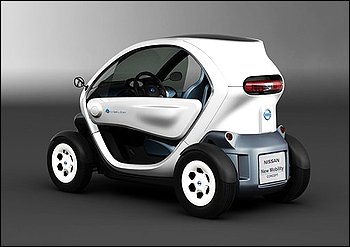
Nissan Unveils New EV Mobility CONCEPT


Nissan showed a two-seater electric vehicle resembling a go-cart Monday that isn't ready for sale but spotlights the Japanese automaker's ambitions to be the leader in zero-emission cars.

Nissan Motor Co. is planning to produce 250,000 electric vehicles a year, starting with the Leaf electric car set for delivery in Japan and the U.S. in December, and next year in Europe.

Its alliance partner Renault SA of France is planning to produce another 250,000 electric vehicles a year.

The two companies together will produce 500,000 batteries for EVs a year, said Nissan, which makes batteries with Japanese electronics maker NEC Corp.

"We don't want EVs to be a niche product," Corporate Vice President Hideaki Watanabe told reporters at the company's headquarters southwest of Tokyo.

He said Nissan boasts 18 years of development experience in lithium-ion batteries, which will power the Leaf, and the company developed its first electric vehicle in 1947. Lithium-ion batteries are common in devices like laptops but will be relatively new for autos.

Then Watanabe zipped around - smoothly and silently as is characteristic of electric vehicles - Nissan's showroom in the tiny electric vehicle called "Nissan New Mobility CONCEPT."

It has a range of a 100 kilometers (62 miles), and maximum speed of 75 kilometers (47 miles) per hour. The EV system was developed by Renault, but the car's design was by Nissan.

Watanabe did not give a price for the concept car. He said uses were still being studied, such as amusement parks and Yokohama city's green mobility projects.

Nissan said it is setting up charging stations for electric vehicles, and forging partnerships with governments and companies, now climbing to more than 80 around the world from 30 last year in an effort to make the move to electric successful.

"That shows how interest in zero-emissions is growing," said Watanabe.

Nissan dealers in Japan will be equipped with battery rechargers with the goal of having 2 million chargers, and an additional 5,000 that recharge quicker, around Japan by 2020, according to the manufacturer of the March subcompact and Infiniti luxury models.

Nissan has set up a company to recycle used EV batteries to reuse and repackage, as well as reselling for back-up and storage.


NISSANEV

MICHELIN Active Wheel Motor Heuliez WiLL Electric Concept car


French coachbuilder Heuliez planned to build the Opel Agila based Heuliez WILL using MICHELIN Active Wheel Motors starting in 2010.

Heuliez will no longer produce cars but has a future as a parts supplier, according to new CEO Francois de Gaillard. In late June, new owners and a 10 million euros ($12.4 million) loan from the French government served to save France's last coachbuilder, which had been under bankruptcy protection.

In an interview de Gaillard said that he doesn't believe that contract manufacturing (supplying complete vehicles to OEMs) has a future. Instead, Heuliez will supply stamped parts and subassemblies to automakers and other industry sectors. De Gaillard said that the company is banking on its reputation for A-class stamped parts such as doors, roof, trunk lids and fenders, as well as for complete hand-made prototypes.

Heuliez will still offer these parts to the auto industry, and the rail and aerospace sectors. Last month, industrial group Baelen Gaillard Industrie (BGI) of France became the sole owner of Heuliez's stamping and body-in-white business after a French bankruptcy court approved the rescue deal. German groups Kohl and ConEnergy got a 68.2% in Heuliez's electric car division, which has been renamed Mia Electric GmbH. Meanwhile, the Poitou-Charentes region, where Heuliez is based, owns the remaining 31.8%.

The fate of the Michelin powered Heuliez WILL is unknown.